
GERALDTON FORESHORE CAMP SPARKS DEBATE OVER HOUSING, PUBLIC SPACE & ‘ABORIGINAL TENT EMBASSY’ LABEL
By Katherine Glass
A short-lived protest camp has been dismantled, but it has left questions about one Aboriginal woman’s public housing concerns, council rules and the culturally loaded language used to draw attention to her case.

City of Greater Geraldton councillor Shane Van Styn said his Facebook posts expressed his personal views. Photo: Facebook
A short-lived camp on Geraldton’s foreshore has been dismantled after a Facebook post about smoke from a fire drew public attention to an Aboriginal woman’s concerns about returning to her public housing property.
City of Greater Geraldton councillor and former mayor Shane Van Styn said he first approached the site after seeing “smoke billowing from out of the sand dunes” near foreshore playgrounds.
He later spoke with the woman, referred to publicly as Julie, and said she told him she felt unsafe at her home because of an ongoing dispute with occupants of a neighbouring public housing property.
Mr Van Styn said Julie wanted the Department of Housing and Works to intervene, either by moving her or addressing the neighbouring tenancy.
He said Julie told him she was fed up after spending more than a year seeking help from the department, other housing services and police without reaching an outcome.
Ngaarda Media has not yet independently verified those allegations or the status of her housing complaint, and Julie was not interviewed for this report.
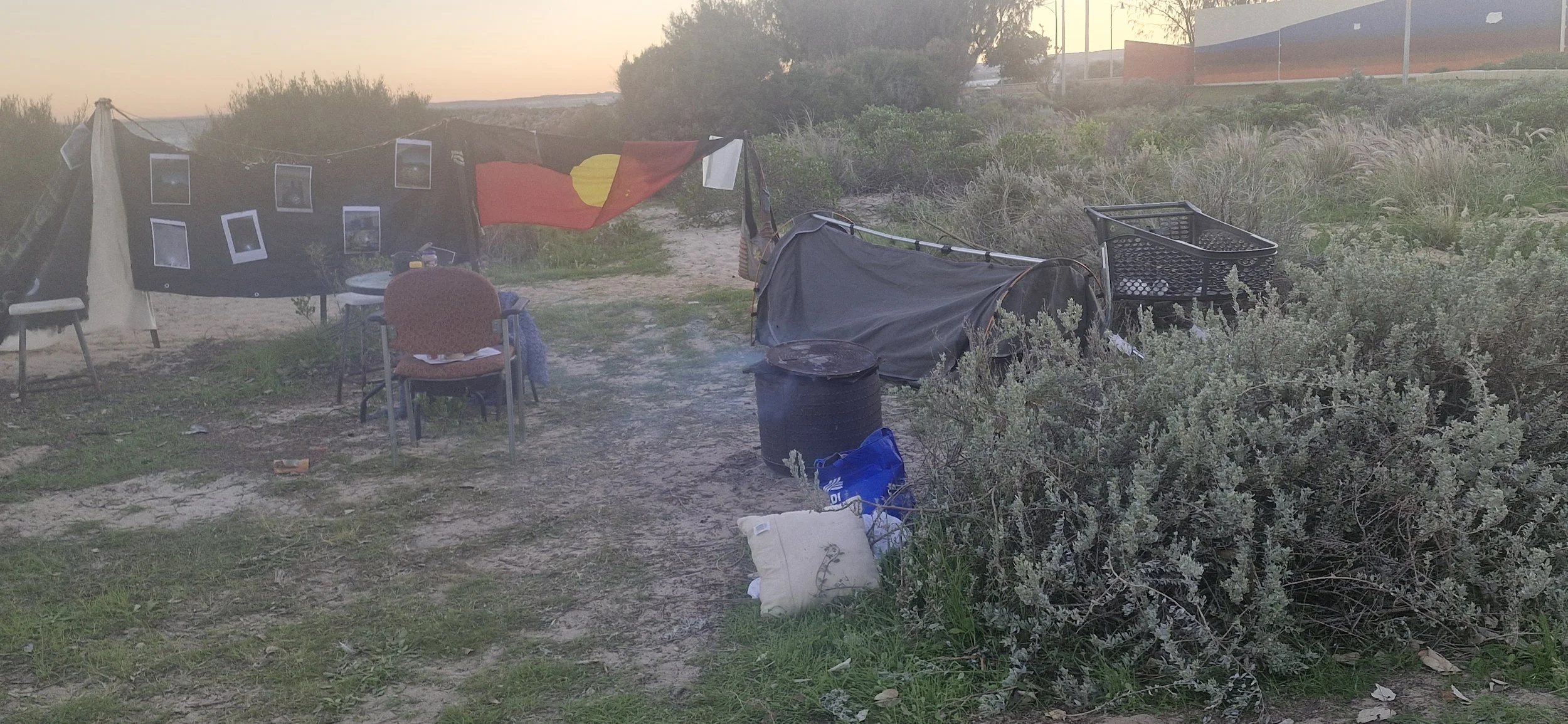
The Geraldton foreshore camp included an Aboriginal flag, displayed photographs, a tent and a metal drum used for a fire. Photo: Shane Van Styn.
Camp removed, but housing complaint remains
At the time of his interview with Ngaarda Media, Mr Van Styn said the camp had been removed following heavy rain, after visits from City rangers, police and firefighters.
He said no formal permission had been granted for the encampment, although that claim has not been independently confirmed by the City.
The City’s Public Places and Local Government Property Local Law says a person must not camp overnight or erect a tent or similar structure on local government property without a permit.
It also prohibits lighting a fire except in a facility provided for that purpose.
Separate City guidance states that cooking fires, campfires and bonfires are not permitted on City-owned or controlled beaches, coastal reserves, bushland or public open spaces.
The guidance provides an exception for enclosed-flame gas appliances, but not for a solid-fuel fire contained in a metal drum.
Mr Van Styn said community concerns included smoke moving across playgrounds, wood being brought into the camp, vehicles obstructing paths and a perception that camping rules were not being applied consistently.
He acknowledged he had not personally been heavily abused, although he said other people had reported hostile encounters.
Those reports have not been independently verified.
Why call it an ‘Aboriginal Tent Embassy’?
Mr Van Styn used the phrase “Geraldton’s Aboriginal Tent Embassy” in a capitalised Facebook headline.
He said banners, an Aboriginal flag and people at the camp who described themselves as ambassadors prompted him to use the term.
When asked whether the wording had sensationalised one woman’s circumstances, Mr Van Styn said he hoped it had elevated her case and prompted authorities and the media to respond.
“I actually hope it did elevate her case,” he said.
“People simply walking by and ignoring it and treating it as nothing to be paid attention to doesn’t help anybody.”
The original Aboriginal Tent Embassy was established outside Parliament House in Canberra in January 1972 by four Aboriginal men protesting the Commonwealth’s approach to land rights.
It grew into a national symbol of sovereignty, land rights and First Nations political resistance, giving the term a significance beyond a temporary camp.
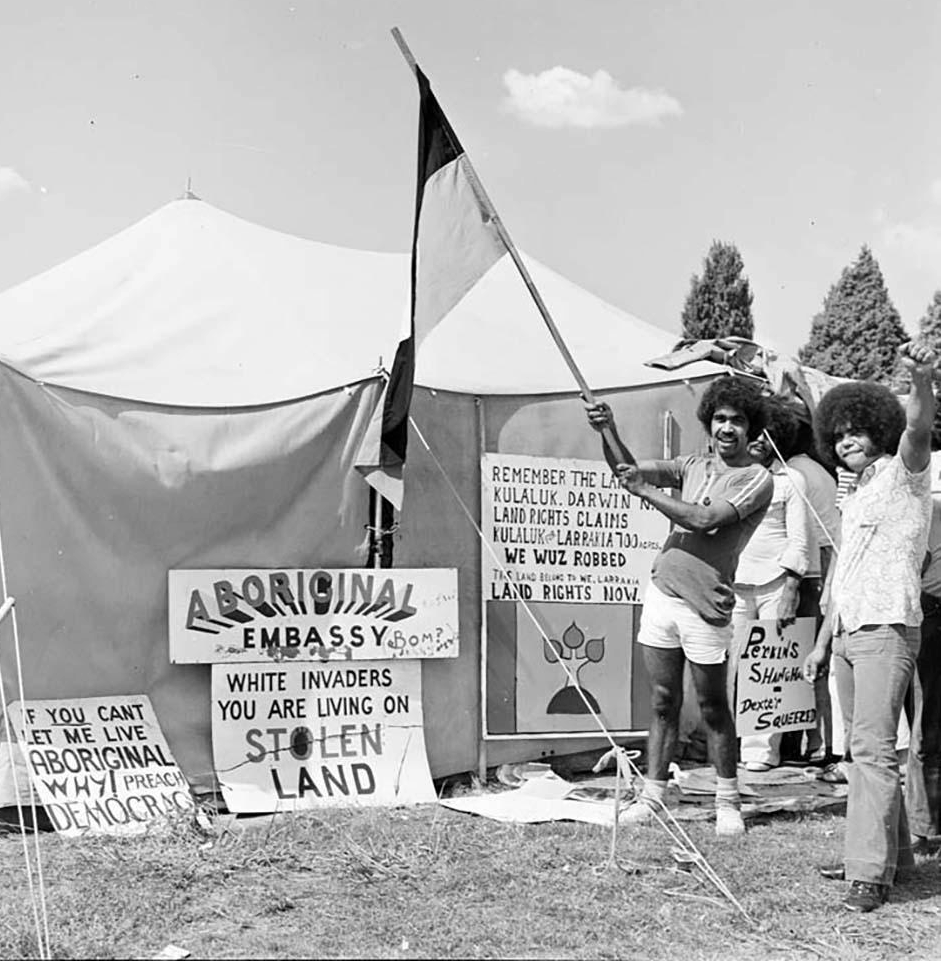
The original Aboriginal Tent Embassy outside Parliament House in Canberra. Photo: Australian Information Service, Canberra.
Mr Van Styn said the Geraldton protest began with Julie’s housing circumstances but expanded to include her views about culture, law and ancestral connection.
He said other people joined the camp during the week, who had their own causes.
Native title position is more complex
Mr Van Styn said Julie told him she was born close to the foreshore and regarded the area as ancestral Country. He said the precise camp site was reclaimed railway land.
Official material about the Yamatji Nation Indigenous Land Use Agreement presents a more complex position.
The 2020 agreement resolved four native title claims across about 48,000 square kilometres in the Mid West, while a Federal Court consent determination recognised native title rights and interests over significant parcels of land.
The settlement also provides compensation for acts that impaired or extinguished native title.
The available material does not establish whether native title applies to the exact foreshore parcel where the camp was located, or whether any recognised right would permit camping there despite local land-management rules.
That would require a parcel-specific assessment of tenure, the determination and any relevant approvals.
Housing pressure predates the protest
The dispute has also renewed attention on a long-running shortage of safe and suitable housing for Aboriginal people in Geraldton.
More recent figures show housing pressure in Geraldton has continued.
As at February 28, 2026, the Geraldton public housing preference zone had 908 waitlist applications, including 320 priority applications.
The City of Greater Geraldton had 1,107 public housing properties, with 127 vacant. Of those, 77 were listed as returning to service, either awaiting acceptance by applicants or undergoing repairs or refurbishment.
Statewide, social housing accounted for 3.8 per cent of Western Australian households in 2025, down from 4.4 per cent in 2016.
By the end of May 2026, the state public housing waitlist had reached 23,637 applications, including 8,241 priority applications.
Nationally, the Closing the Gap target is for 88 per cent of Aboriginal and Torres Strait Islander people to live in appropriately sized housing by 2031.
The latest census-based figure on the Productivity Commission dashboard is 81.4 per cent for 2021.
The WA Government has acknowledged that its existing waitlist system does not adequately reflect the complex circumstances of people seeking social housing.
A proposed priority assessment model will consider safety, housing circumstances, medical and accessibility needs, as well as cultural considerations such as multigenerational living and access to family and community support.
The new model is not expected to begin operating until 2028.
The proposed criteria may be relevant to circumstances such as those reported by Julie, who remains a public housing tenant but says she does not feel safe returning to her property.
The 2026–27 WA Budget includes a record $4.7 billion housing package, including $452 million for new social housing, refurbishments, land acquisition and maintenance, and $692 million for regional housing.
It also includes a $127 million top-up to the Remote Communities Fund for housing, utilities and services in remote Aboriginal communities.
That Aboriginal-specific funding is directed to remote communities and does not necessarily address urban public housing pressures in Geraldton.
Mr Van Styn said Geraldton’s social housing system was “really bad, not appalling” and claimed a local campaign had helped reduce the number of boarded-up public homes.
Housing and Works says complaints about disruptive behaviour can be reported to the department, while immediate safety concerns and suspected illegal activity should be referred to WA Police.
The department says it investigates whether a public housing tenant has breached the Residential Tenancies Act.
Posts were personal views, councillor says
Mr Van Styn said his Facebook posts were made in a personal capacity and did not represent the City of Greater Geraldton.
“Everything there is my opinion. I don’t get to speak on behalf of the council — that’s the role of the mayor,” he said.
He said he wanted Housing and Works, service providers and local Aboriginal organisations to help resolve the dispute and determine whether the neighbouring housing arrangement was suitable.
Mr Van Styn described Julie as a well-regarded woman and said he hoped her concerns could be resolved.
The outcome of her housing complaint was not known at the time of publication.