
INDIGENOUS PROCUREMENT REFORMS ALONE WILL NOT DELIVER MORE WORK TO PILBARA AND KIMBERLEY BUSINESSES, RESEARCHER SAYS

Dr Christian Eva. Image by Artificial Studios.
By Katherine Glass
Stronger rules governing which Indigenous businesses can access Commonwealth contracts will not automatically bring more work to the Pilbara and Kimberley, a researcher says, calling for greater support for regional enterprises and more Indigenous control over procurement policy.
Dr Christian Eva says moving to majority Indigenous ownership and control is an important change, but it does not resolve the barriers smaller businesses face when competing against established suppliers.
Speaking to Ngaarda Media on July 31, the University of Melbourne senior lecturer said changing eligibility was different from changing where government spending flowed.
“In terms of what this means for businesses in the Pilbara or the Kimberley, I don't expect that this is gonna have any particular change on the amount or the kind of contracts that they would receive,” he said.
“The change to how the policy is now operating is not going to suddenly redistribute the kind of contracts to a broader range of firms.”
Dr Eva, who works at the Dilin Duwa Centre for Indigenous Business Leadership, said regional businesses needed support to develop their capacity, alongside stronger incentives for government agencies to engage them.
“They have to … be supported to be able to be in a place and a position to be able to win those contracts,” he said.
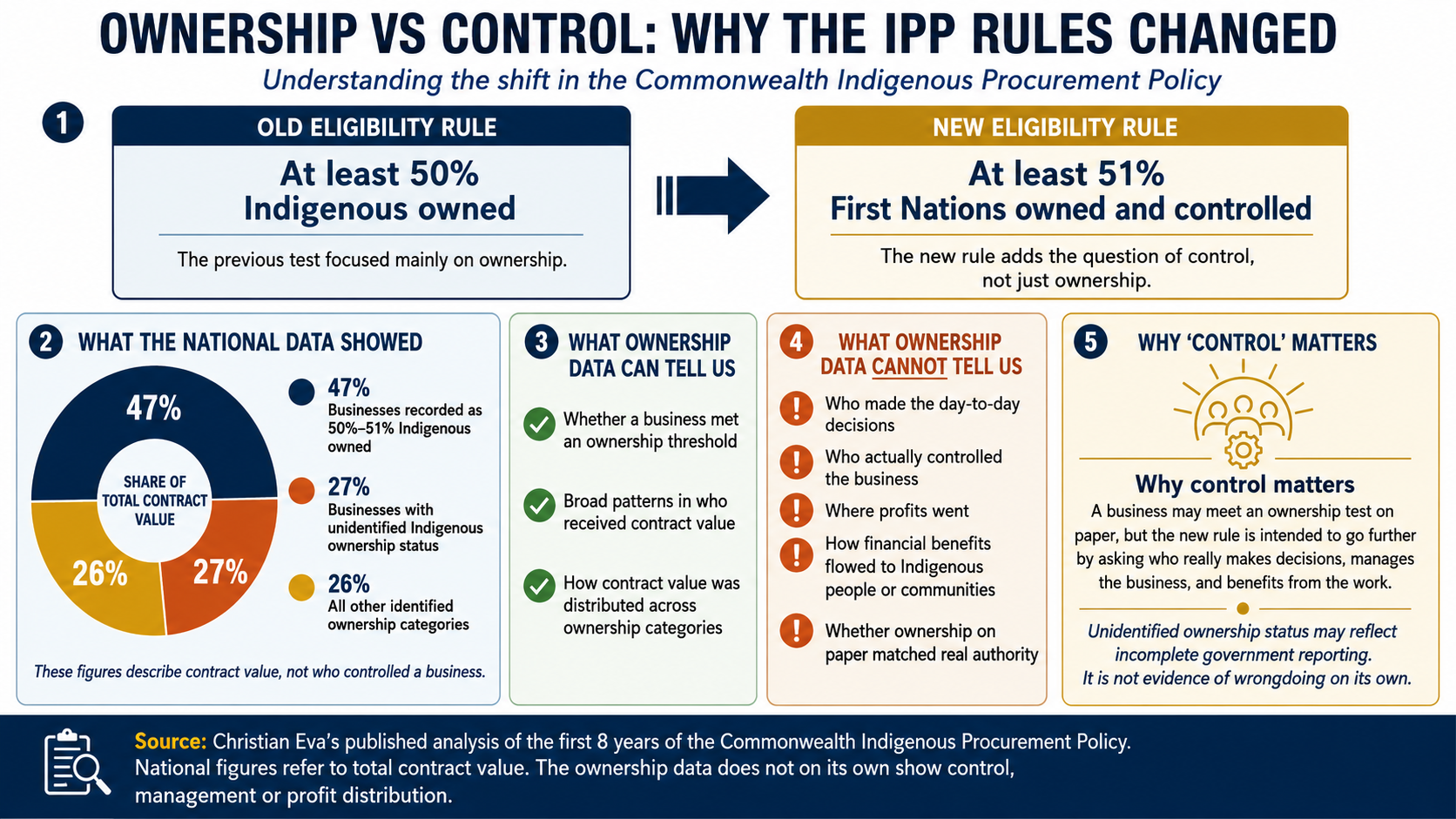
Ownership vs Control Infographic by Katherine Glass
What has changed?
Introduced in 2015, the Indigenous Procurement Policy aims to increase Commonwealth purchasing from Aboriginal and Torres Strait Islander businesses.
The National Indigenous Australians Agency says the policy generated more than $13.5 billion in contracting opportunities between its introduction and February 2026, involving more than 86,000 contracts awarded to more than 4,700 Indigenous businesses. These are national figures, rather than a measure of benefits reaching individual regions.
Strengthened eligibility criteria commenced on July 1, 2026. They require businesses to be at least 51 per cent First Nations owned and controlled, or registered with the Office of the Registrar of Indigenous Corporations.
However, transitional arrangements allow businesses meeting the original threshold of at least 50 per cent Indigenous ownership to continue accessing the policy during 2026–27.
Dr Eva said the move from equal ownership to majority ownership reflected longstanding advocacy within the Indigenous business sector.
But he said a business’s ownership structure did not necessarily reveal who made its financial decisions or managed its daily operations.
“It might be that the business itself is owned by an Indigenous person, but the financial decisions that the business makes or the day-to-day operations that the business undertakes … primarily sits with a non-Indigenous party,” he said.
He said assessing control was intended to address arrangements that met ownership requirements without giving Indigenous owners meaningful authority.
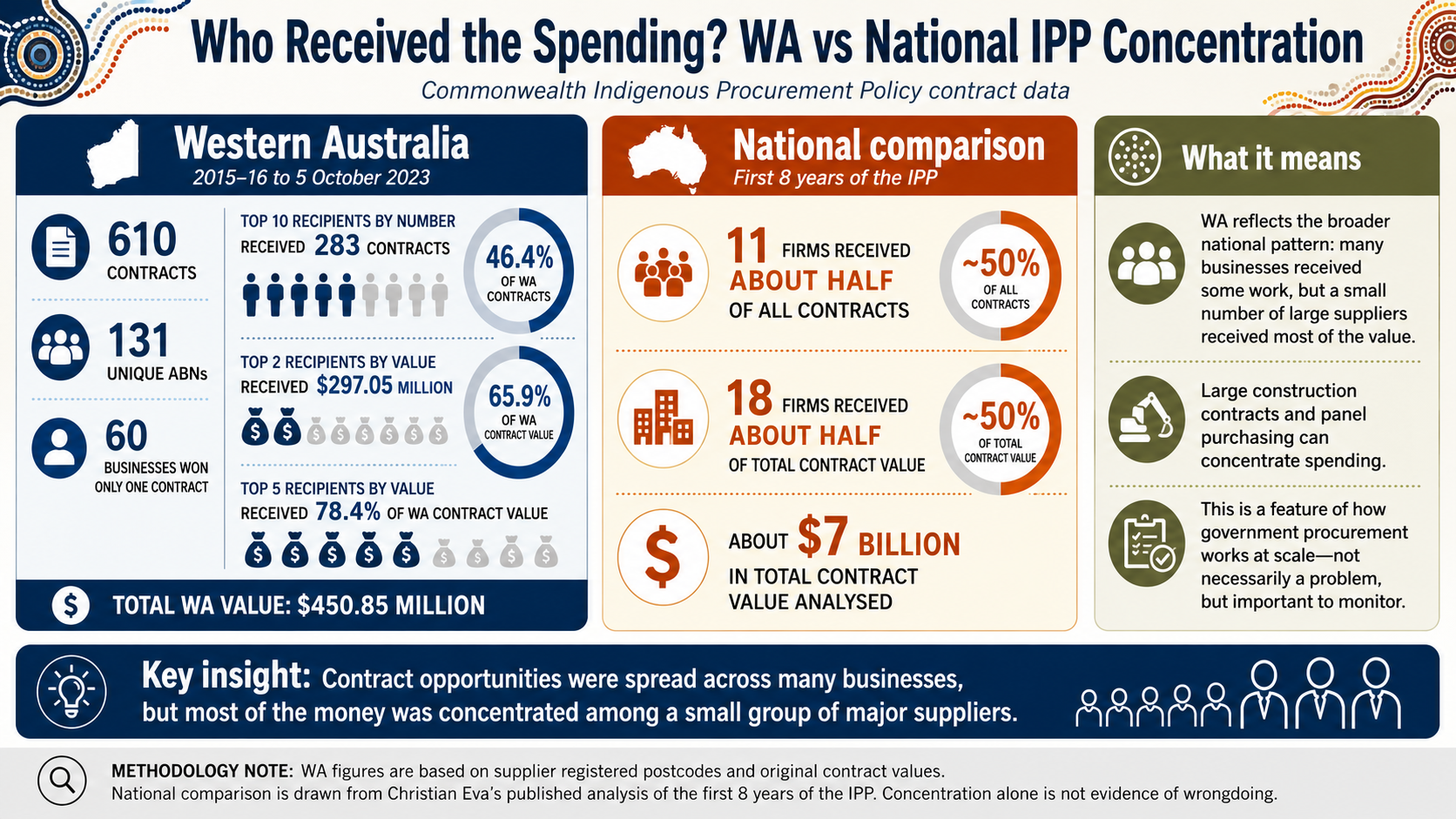
IPP Spending Infographic by Katherine Glass
An opportunity does not guarantee a contract
Dr Eva said the policy opened doors, but businesses still had to demonstrate they could deliver the goods or services government wanted.
“No, it definitely does not guarantee a contract,” he said.
“At the end of the day … it is still a public procurement process.”
The policy includes annual purchasing targets and a mandatory set-aside, which requires Indigenous suppliers to be given an opportunity to demonstrate value for money before a wider approach to market for specified procurements.
That includes work delivered in remote Australia and other procurements wholly delivered in Australia worth between $80,000 and $200,000, including GST.
Dr Eva said larger businesses could have advantages through established relationships, greater resources and a longer record of delivering contracts.
Those pressures also existed when Indigenous businesses competed against one another.
“The incentivisation is for them to find an Indigenous-owned firm,” he said.
Regional and remote businesses nevertheless had strengths, particularly when contracts involved work within their own communities.
“There are definitely comparative advantages for regional and remote located businesses … to be undertaking work that serves their local community,” he said.
Support needed to turn opportunities into work
Dr Eva said governments needed to consider whether smaller enterprises were equipped to pursue the opportunities being offered.
Simply making a contract available did not address the financial and organisational barriers that could prevent a business from competing.
“So, I think it goes beyond just increasing the targets or changing eligibility,” he said.
He called for more deliberate consideration of how contracts were distributed, alongside investment in the capacity of regional and remote businesses.
“There needs to be an incentive from the government side to actually be more inclined or need to engage with remote and regional Aboriginal businesses more frequently and more meaningfully,” he said.
Dr Eva said Aboriginal community-controlled organisations played a crucial role in delivering government-funded services.
Repeat contracts could provide consistency, even when their value was much smaller than major construction projects.
But he said investment concentrated in particular services would not necessarily support the full range of enterprises communities wanted to establish.
He said governments should work with communities to understand their economic priorities, including opportunities beyond public procurement.
“Public procurement is only one economic policy lever that we have in our toolkit,” he said.
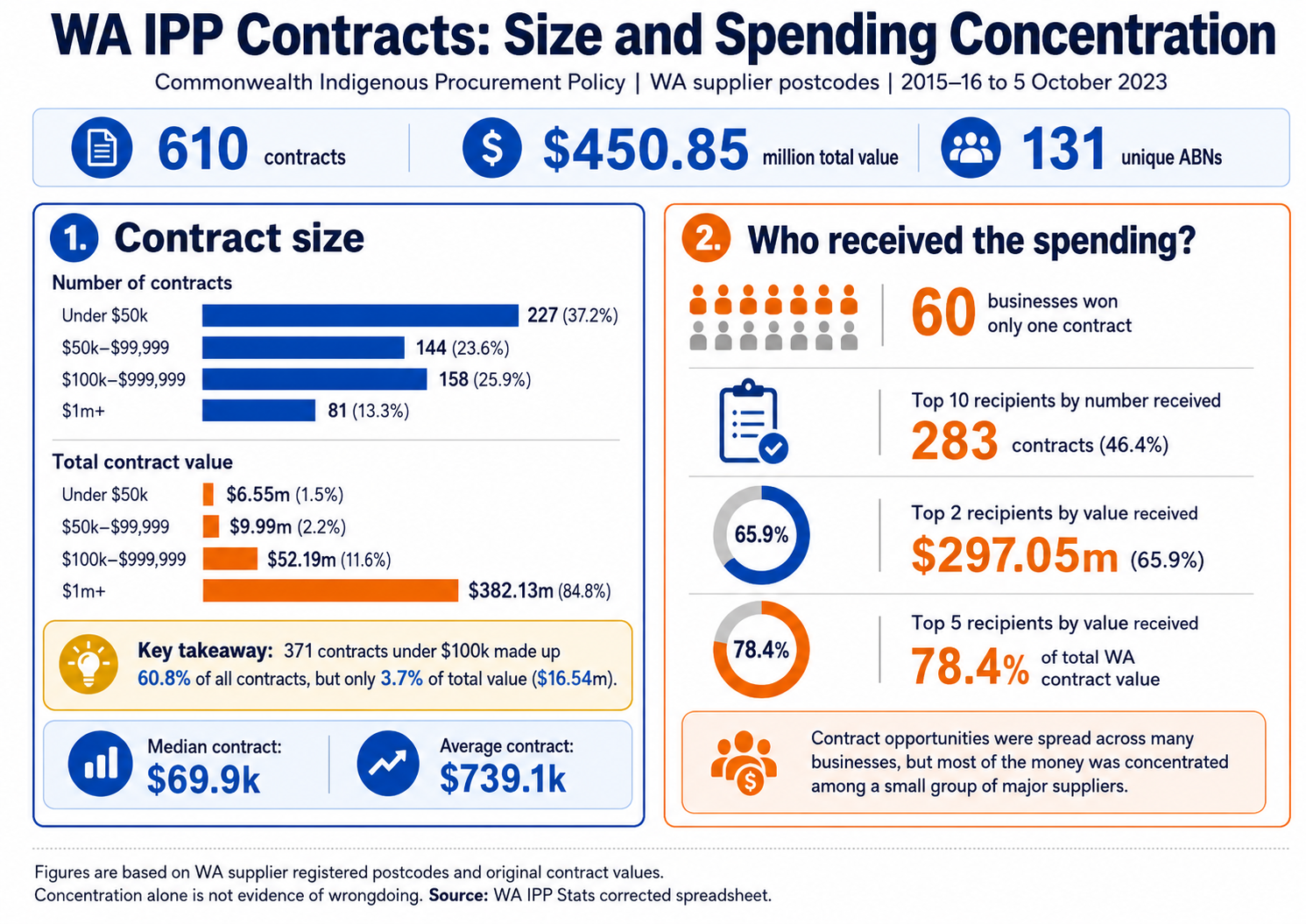
WA IPP Contracts Infographic by Katherine Glass
Verification arrangements still developing
In the July interview, Dr Eva questioned how the Commonwealth would define and verify Indigenous control without placing excessive administrative demands on business owners.
The NIAA’s published guidance says a tender for a new Indigenous business verification and registry service closed on September 18.
It says further guidance will be developed once a provider is in place. Businesses already registered under the original eligibility criteria will have 12 months from the commencement of the strengthened verification service to meet the new requirements.
Dr Eva also called for better reporting to help communities assess who was benefiting from procurement spending.
“There are so many questions that are left unanswered because the kind of information that is collected is very, very thin,” he said.
Indigenous communities should define success
For businesses considering government work, Dr Eva encouraged building relationships with Indigenous business chambers and Supply Nation, and seeking feedback after unsuccessful bids.
“If you're not winning contracts, to then follow up and say, ‘Well, why? What can we do to change?’” he said.
But he said the broader question was who determined the policy’s priorities and judged its success.
“A successful Indigenous procurement policy five years from now would look like one that is governed by Indigenous peoples,” he said.
He said communities could hear national accounts of the policy’s success while seeing little additional opportunity locally.
“What I would like to see in terms of successful policy going forward is … giving that power back to Indigenous people to determine what they want from this policy.”
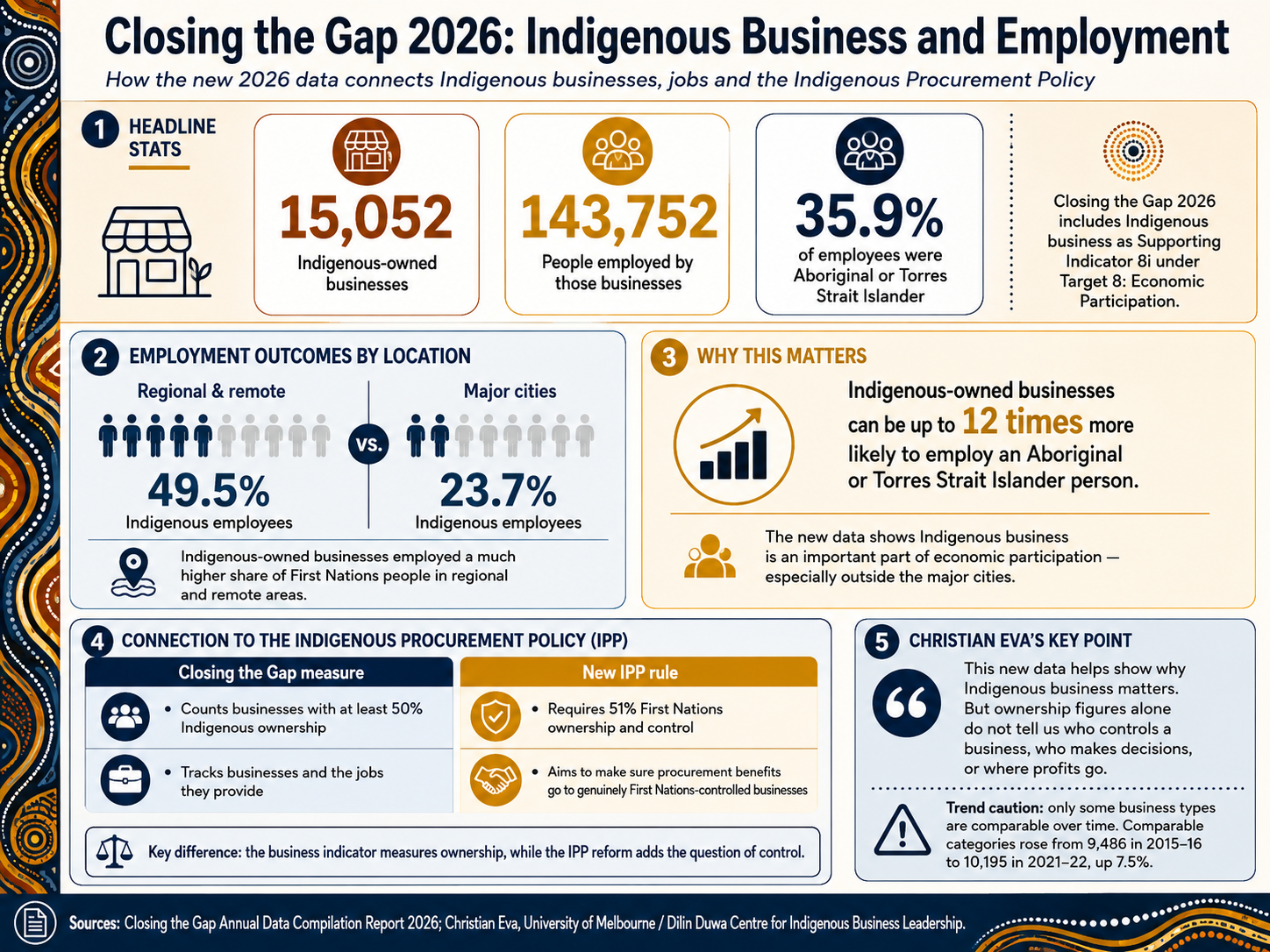
Closing the Gap: Indigenous Business and Employment Infographic by Katherine Glass