
LITHIUM-ION BATTERY FIRES SURGE ACROSS WA AS DFES WARNS PILBARA HEAT CAN ADD TO RISK

Department of Fire and Emergency Services district officer Mark Hayes. Image: Facebook
By Katherine J Glass
More than 230 lithium-ion battery fires have been recorded across Western Australia in the past 12 months, as fire authorities warn extreme heat and ageing e-scooter batteries can create added risks in regions such as the Pilbara.
Department of Fire and Emergency Services district officer Mark Hayes said lithium-ion battery fires had been increasing for years, with e-scooters and other e-rideables emerging as a major concern.
“Over the last 12 months, well, over 230, and we’re looking at eclipsing that this year,” Mr Hayes told Ngaarda Media.
“It’s been increasing every year since we started noticing lithium battery fires, which is around 2017.”
The latest figure continues a steep upward trend.
DFES data shows 48 lithium-ion battery fires were recorded across WA in 2020, rising to 69 in 2021, 90 in 2022 and 110 in 2023.
The number jumped again to 166 fires in 2024, making it the state's worst year on record and representing an increase of about 246 per cent compared with 2020.
By August 2025, firefighters had already attended 94 lithium-ion battery fires for that year, including 19 involving e-rideables.
DFES now says firefighters are responding to more than three battery-related incidents each week.
E-SCOOTERS AMONG THE BIGGEST CONCERNS
Lithium-ion batteries are used in an increasingly wide range of products, from mobile phones and laptops to cordless vacuum cleaners, power tools, electric toothbrushes, children's toys and e-bikes.
But Mr Hayes said e-rideables were particularly concerning because of the treatment their batteries could receive during everyday use.
“Certainly e-rideables, they top it,” he said.
“They don’t get looked after. The batteries are at the bottom of the scooter [and] people are riding those scooters.”
Physical damage, excessive heat, incorrect chargers and battery deterioration can all increase the risk of failure.
DFES describes e-rideables as a leading lithium-ion battery fire hazard and warns consumers to be cautious when buying second-hand devices because batteries may already be damaged or nearing the end of their useful life.
Mr Hayes said people considering a second-hand scooter should think about why it was being sold.
“Second-hand stuff is at risk,” he said.
“The older the battery gets, the more dangerous it becomes.”
PILBARA HEAT CAN ADD ANOTHER FACTOR
DFES does not have a specific breakdown of lithium-ion battery fires for the Pilbara, with Mr Hayes saying incidents are currently recorded at a statewide level.
But he said the region's high temperatures could add to the conditions affecting batteries, particularly in e-scooters that had already been used heavily.
Mr Hayes said a scooter ridden during a hot Pilbara day could already have a warm battery before it was brought home.
“It gets ridden during the day, so it’s hot already and it’s picking up a bit of heat off the road,” he said.
“So the battery is already warm and then it gets used until it runs out of charge, and then the battery gets put on charge while it’s still hot.”
He said that combination could keep the battery at an elevated temperature.
The risk has already been seen in the region.
In June 2024, an e-rideable battery was blamed for a fire that destroyed a home in Karratha, one of two serious WA house fires involving the devices within the space of a week.
DFES advises lithium-ion batteries should be stored in cool, dry locations and protected from high temperatures and physical damage.
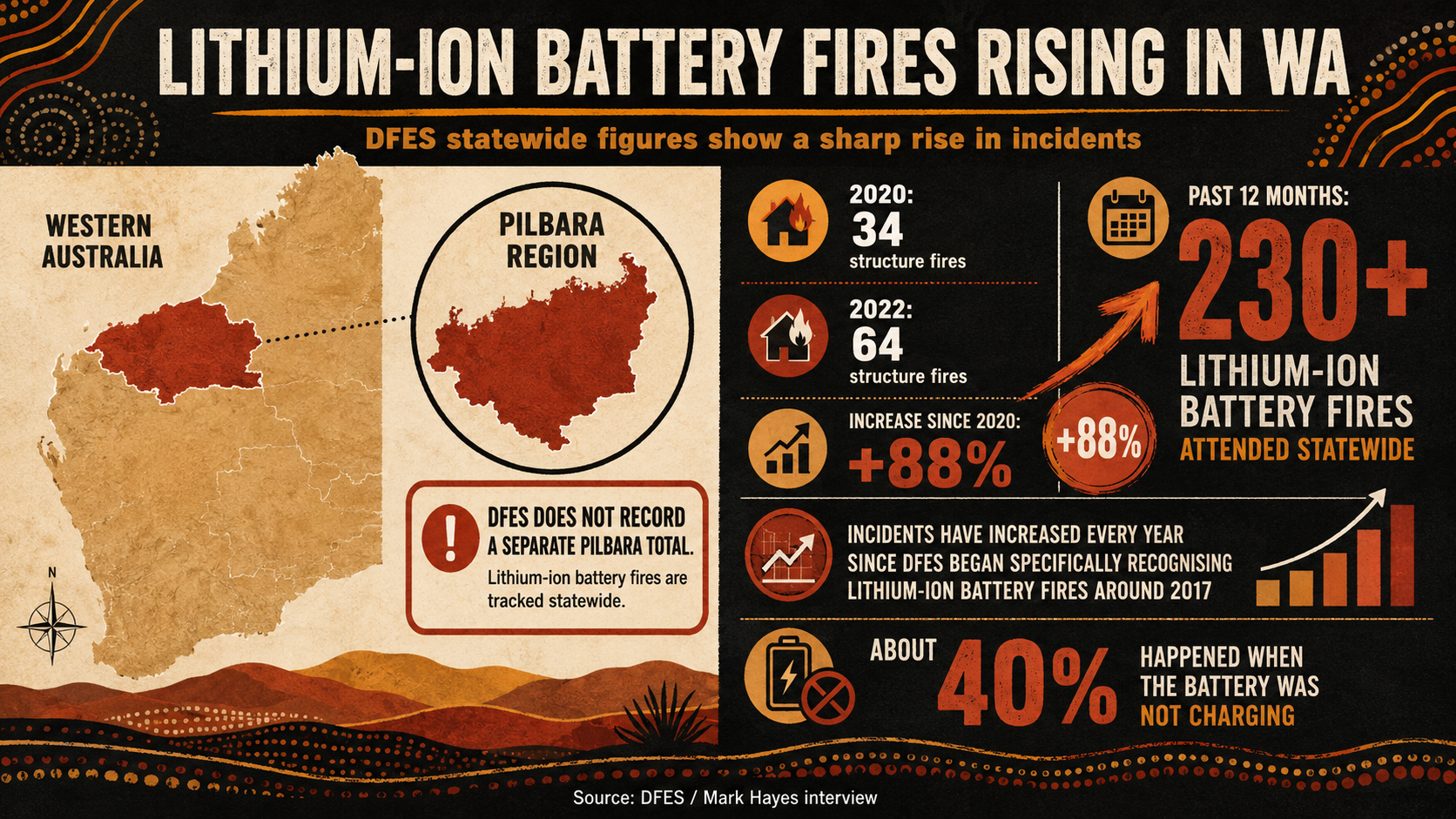
Lithium Ion battery fires rising in WA infographic by Ngaarda Media
WHAT IS THERMAL RUNAWAY?
One of the most dangerous battery failures is known as thermal runaway.
It occurs when the temperature inside a battery begins increasing faster than the heat can escape.
Mr Hayes said the battery could continue heating until gases built up inside its casing.
“The first thing you’ll notice is the battery getting warmer and it won’t slow down,” he said.
“Eventually you’ll hear it start to hiss.”
Other warning signs identified by DFES include swelling, cracking, leaking, unusual smells, excessive heat and popping or hissing noises.
Mr Hayes warned people not to attempt to handle an e-scooter or other large battery once it was smoking or entering thermal runaway.
“I wouldn’t touch it,” he said.
“I would evacuate the house immediately and call triple zero.”
He said a damaged or overheating battery that remained intact and had not entered thermal runaway could be placed in water to help stop the heat building — but people should not put themselves at risk attempting to move a battery that was already smoking or burning.
FIRES CAN START EVEN WHEN BATTERIES ARE NOT CHARGING
Mr Hayes said another misconception was that lithium-ion batteries only posed a fire risk while connected to a charger.
“Forty-odd per cent of the fires that DFES attends across the state, the batteries aren’t on charge,” he said.
That means simply unplugging a device does not eliminate the risk if its battery has already been damaged or is deteriorating.
Mr Hayes said people needed to recognise lithium-ion batteries were fundamentally different from traditional disposable household batteries.
“It’s not like a AAA battery or a AA battery,” he said.
“It is a chemical reaction that’s occurring inside a little case.”
WRONG CHARGERS AND OVERNIGHT CHARGING
Mr Hayes also warned against using replacement chargers that were not designed for a particular battery.
He said the battery management system and charger were designed to communicate electronically to control charging.
“If you’re not using a charger that’s designed and tuned to that battery management system, there’s no conversation, per se, between the battery and the charging unit,” he said.
DFES recommends using equipment supplied or approved by reputable manufacturers and avoiding incompatible replacement batteries or chargers.
But Mr Hayes said one of the simplest safety changes people could make was not leaving rechargeable devices connected overnight.
“Take them off charge when you go to bed,” he said.
“Don’t leave them on charge when you leave the house.”
DFES also recommends charging devices on hard surfaces away from beds, lounges and other combustible materials, regularly checking batteries for damage or overheating, and installing smoke or heat alarms where e-rideables and other large batteries are stored or charged.
For Mr Hayes, the warning applies well beyond people who own an electric scooter.
“Everybody’s got lithium-ion batteries in their home,” he said.
“Everybody needs to be cautious with them.”
For Pilbara families, the message is simple: a little more care with batteries can make the difference between a useful everyday device and a serious fire emergency.
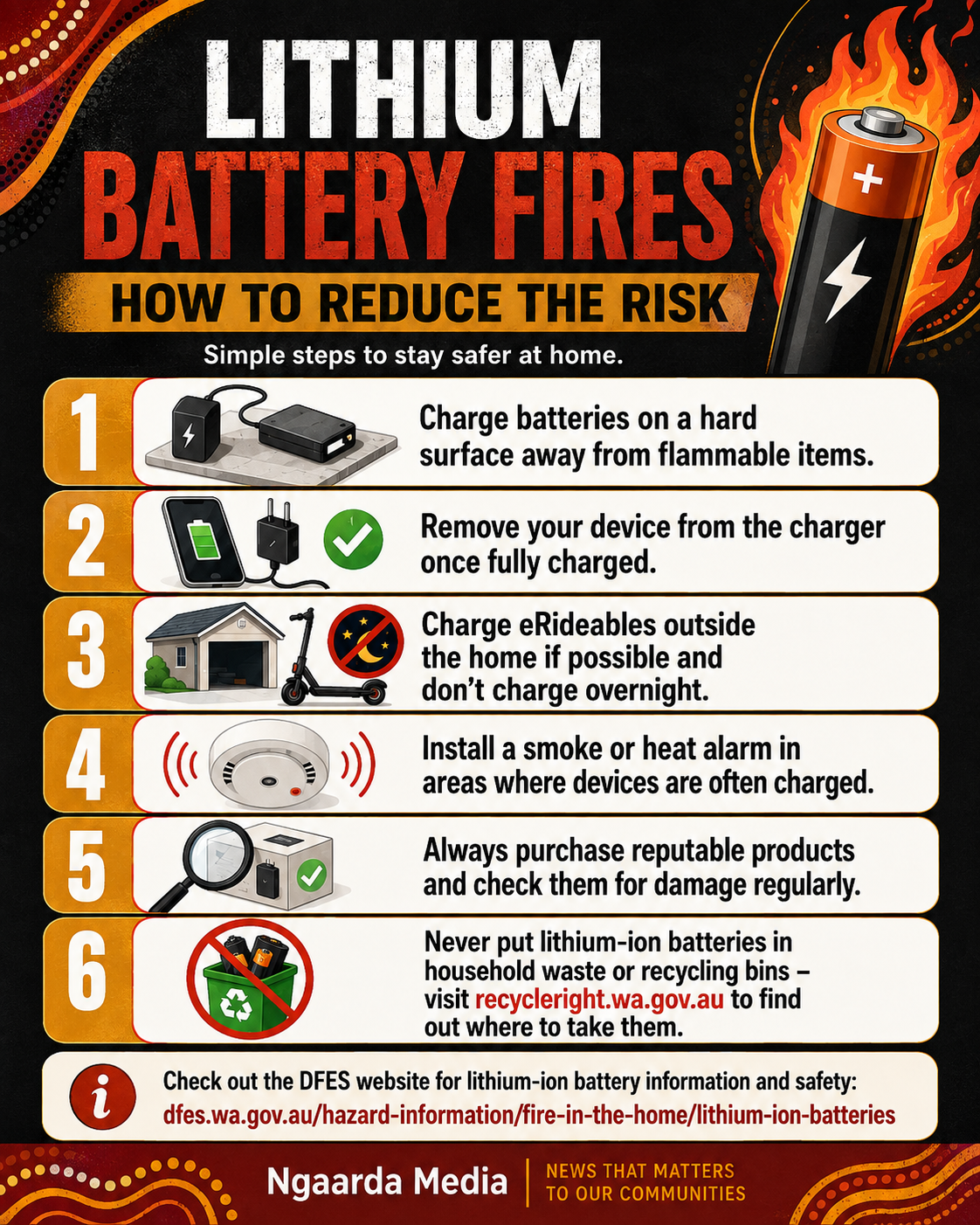
Fire Safety Infographic by Ngaarda Media