
ROBE RIVER KURUMA PEOPLE CELEBRATE TEN YEARS OF NATIVE TITLE RECOGNITION
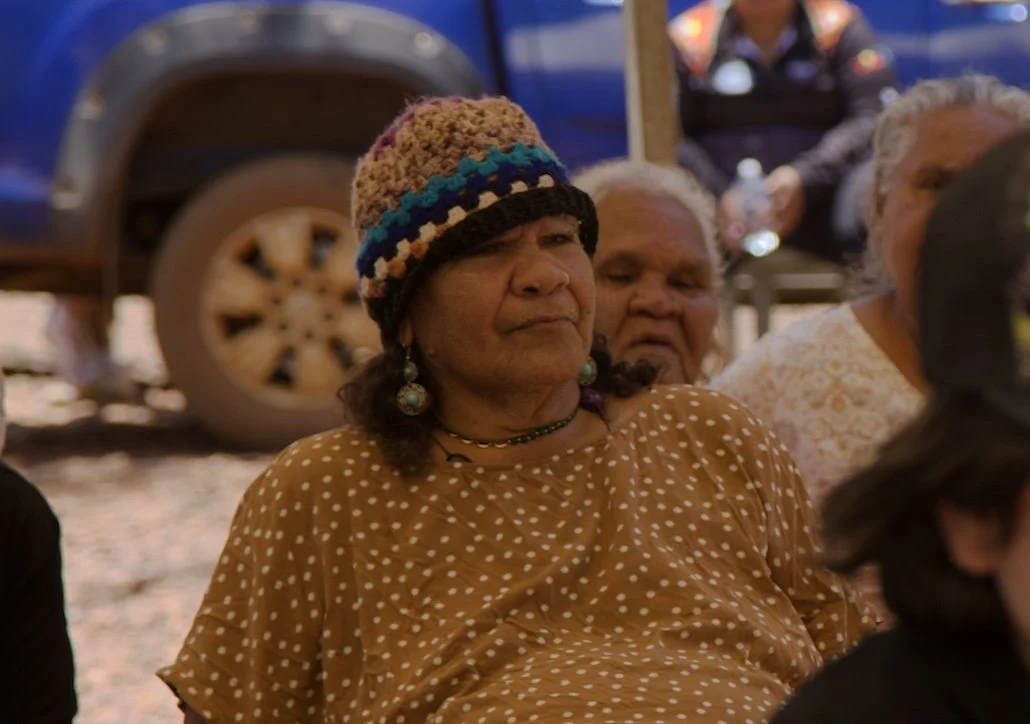
Robe River Kuruma Elder Gloria Lockyer at Paarlapunni. Image by Jensen Pryar
By Katherine J Glass
Families have gathered on Country in Western Australia's Pilbara to mark a decade since the recognition of their native title rights, remembering those who fought for recognition and calling for stronger protection of Country.
For Robe River Kuruma Elder Gloria Lockyer, celebrating 10 years of native title recognition is both a proud moment and a reminder of the people who are no longer here to share it.
Families and Traditional Owners gathered at Parlapuuni, also known as Pannawonica Hill, on Sunday before continuing celebrations at Pannawonica Oval.
The anniversary marked a decade since the Federal Court formally recognised the Robe River Kuruma people's native title rights over part of their traditional lands on 1 November 2016.
But Ms Lockyer said the journey to that recognition had begun many years earlier.
"We started to get organising ourselves to get native title for our country," she told Ngaarda Media.
"Even though we are now celebrating only 10 years, it goes way back more than 10 years, almost 25 years.
"A good part of my life in helping our people to get native title. So it's been a big struggle."
The celebrations brought generations of families together, with cultural activities, live music, children's entertainment and a photographic exhibition reflecting on the community's history.
For Ms Lockyer, the occasion was particularly significant because of the Elders who had helped lead the struggle but had since passed away.
"The only thing is we don't have our people, our old people who have helped us on this journey," she said.
"But memories are good. Absolutely happy."
A legal battle spanning two decades
The Robe River Kuruma people's native title claim dates back to the 1990s.
On 1 November 2016, Federal Court Justice Michael Barker handed down a consent determination at Mindoona on the Robe River, recognising exclusive and non-exclusive native title rights over approximately 4,123 square kilometres of land in the Hamersley Ranges.
A second determination followed on 26 April 2018, when Federal Court Justice Darryl Rangiah recognised rights over a further approximately 5,720 square kilometres, including the middle Robe River, Bungaroo Valley and Buckland Ranges.
Together, the determinations recognised the community's continuing connection to Country following more than two decades of legal proceedings.
At the afternoon gathering, Kelly Slattery spoke about the importance of that achievement and the generations who had made it possible.
"Native title recognition is an important achievement, but it didn't give us our connection to country. That was already there," she said.
"What it did was formally recognise something that people have always known, that this is our country, and that we have rights, responsibilities, and a continuing connection to it."
Ms Slattery also acknowledged the contribution of Elders who had not lived to see the anniversary.
"We remember what they stood for, what they fought for, and what they wanted for their children and grandchildren, and we owe them a great deal.
"I think they would be very proud to see us all gathered here today."
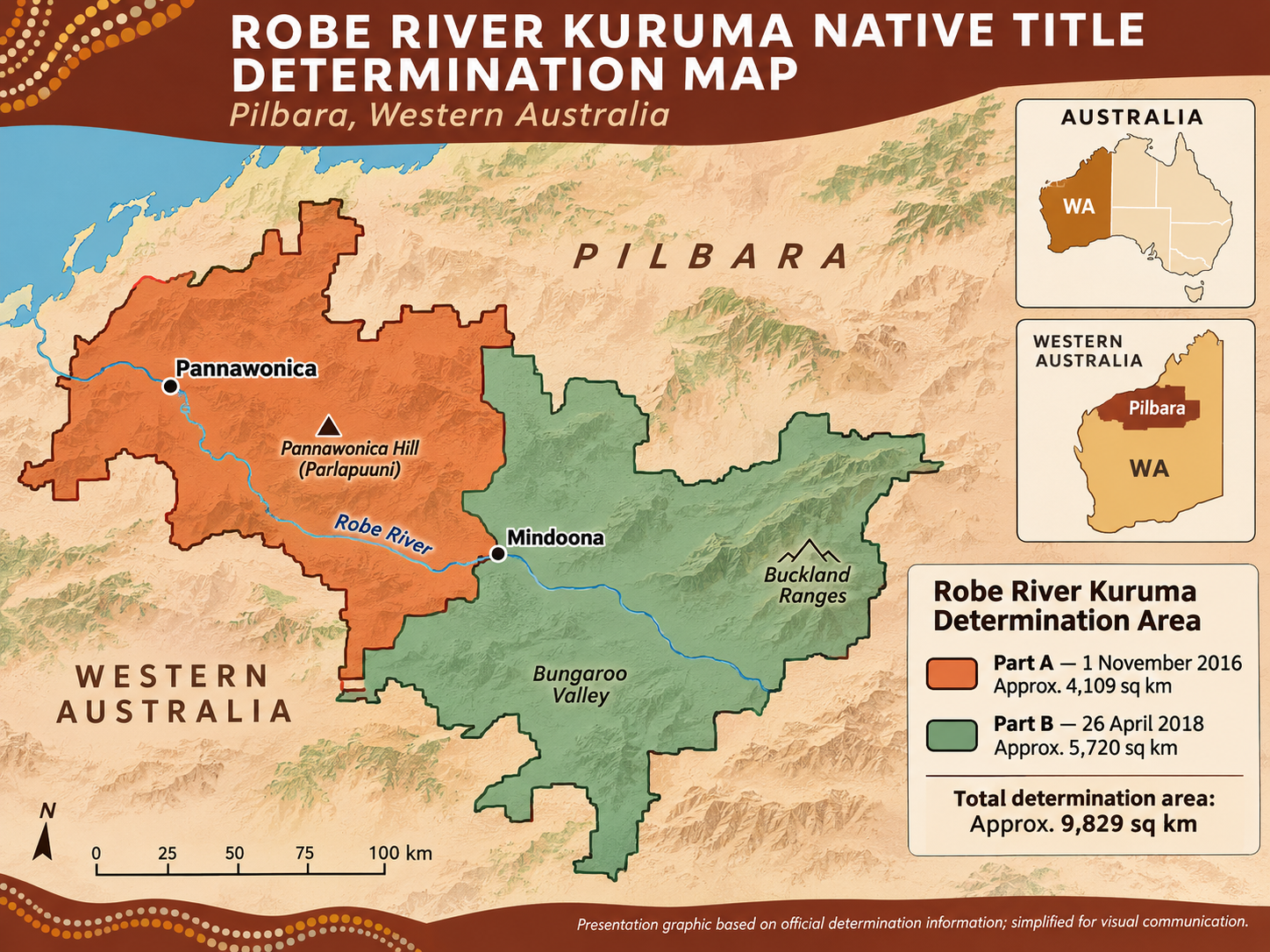
Robe River Kuruma Determination map. Digital Image by Katherine Glass
The stories held within Pannawonica Hill
Pannawonica Hill is a place of cultural significance for Robe River Kuruma people.
The morning gathering at Parlapuuni carried particular significance for Traditional Owners.
Ms Lockyer shared the Dreaming story of the hill, which she said was once connected to another hill in the ocean.
According to the story passed down by her Elders, ancestral beings transformed into birds and carried the hill to its present location.
She described how the story also reflected longstanding cultural relationships between neighbouring groups.
"It did happen and that's what we believe in," she said.
"There'll always be that connection between the Marthudunera and the Kuruma people because our old people actually married into both tribes too."
For Ms Lockyer, the importance of the hill extends beyond its physical landscape.
It represents the stories, responsibilities and cultural knowledge passed through generations.
"Oh yes, and yes, and they were all handed down by our old people," she said.
"What history we've learned, it's always handed down to our younger generation."
She recalled how her granddaughter had recently asked her to share stories about Country.
"It's good that they are hungry, they're even at a small age, they're wanting to know more information about what's on the country," she said.
The Elder said younger generations needed to understand culturally significant places, including sites associated with rainmaking, animals and bush plants.
"It's very important we learn our younger generation that," she said.
"Also important to teach our children about important sites which we have on the country.
"Because that's why I believe we're still here, is to protect the country."
Native title recognition and the continuing challenge of mining
While the anniversary was an opportunity to celebrate, Ms Lockyer said the protection of Country remained a major concern.
She reflected on the changes she had witnessed across the Robe River region as mining operations expanded.
Her father, she said, had spoken about the importance of retaining the identity of hills and other culturally significant features in the landscape.
Ms Lockyer recalled arguing that even when mining disturbed a hill, enough of its original form should remain for future generations to recognise it.
"Leave the rims," she said.
"So they can take out the ore, but leave the rims, so then if that hill has a name, it leaves its identification."
She said the extent of mining activity along the Robe River was deeply troubling.
"Heaps, heaps all along the Robe River itself," she said when asked how much Country had been affected.
"Looking at the Middle Robe now, it's so sad because going back on what my father had told me about certain hills losing their identity."
Ms Lockyer said she was concerned about the possibility of previously mined areas being revisited.
"I disagree with that. I really do," she said.
The Elder also questioned how much practical influence native title recognition had provided Traditional Owners.
"I believe, well, not much power from native title. I still have to understand fully on exactly what rights we have," she said.
"But as an Elder for this country, and talking for so long for our people and country, it's very frustrating.
"But I do believe we're making progress."
She also called for greater involvement of Elders in decisions affecting the community and its relationship with mining companies, including Rio Tinto.
"I would like to see more Elders sitting on the board," she said.
"Just to make Rio know there's people watching you, watching Rio.
"I think that's very important. I've voiced that before and I'll voice it again. That needs to happen."
A new generation taking responsibility for Country
Despite those concerns, Ms Lockyer said she was encouraged by the younger generation's involvement in caring for Country.
She pointed to the community's ranger program as an important opportunity for young people to develop their knowledge and take responsibility for protecting the landscape.
"We have the young rangers, they're up and going for us," she said.
"We've got a lot of young people that are on rangers."
But she said greater guidance from Elders would help strengthen that work.
"I do believe they need more direction from the Elders on what they do out there to protect and clean our country."
Language preservation was another priority.
Ms Lockyer said she wanted to learn more of the Robe River Kuruma language and see it passed to her children.
"I'd love to learn. I mean, we're never too old to learn," she said.
"That's something I want to learn and I want my children to learn, our Kuruma language, to keep it thriving."
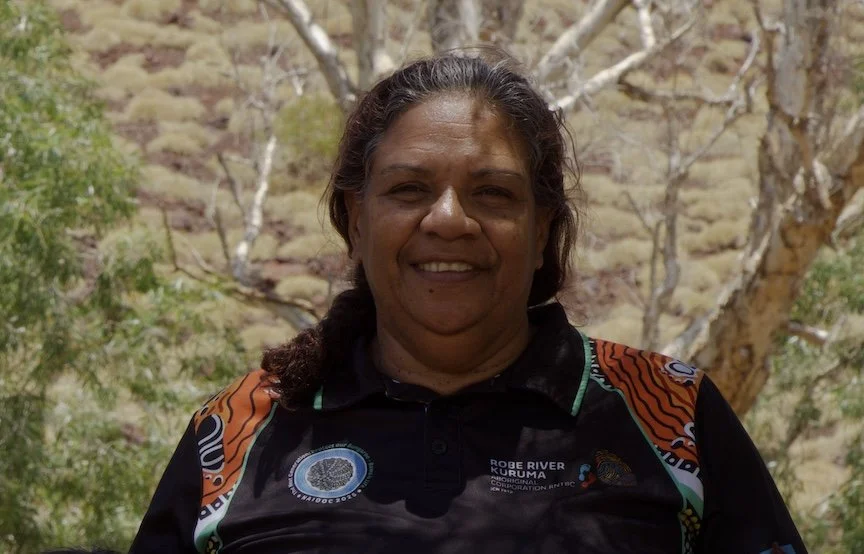
Traditional Owner Leanne Evans at Paalarpuni. Image by Jensen Pryar.
Remembering those who carried the fight
At the anniversary gathering, family members also shared memories of the long journey towards native title recognition and the importance of looking after one another.
Traditional Owner Leanne Evans reflected on the strength of family relationships and the responsibility of passing knowledge between generations.
"We all share the same blood," Leanne said.
"It's a very special day for us."
She also remembered those who had passed away during the long struggle.
"It's been a long journey. And we lost our old people, but they left the knowledge for us to carry on. That's the most important thing."
At the afternoon celebration, Ms Kelly Slattery said the next chapter would involve strengthening the organisation, creating opportunities and making sure Traditional Owners continued to have a voice in decisions about their Country.
"It is our responsibility to honour that legacy by continuing to build something strong for the generations that follow us," she said.
The anniversary program also featured a preview of a documentary recording the people and experiences behind the native title journey.
For Ms Lockyer, the gathering was an opportunity to reconnect with relatives, celebrate the achievement and reflect on everything that had changed.
"It's just a beautiful day and I'm glad everyone's enjoying themselves," she said.
"It's good to see faces that I don't get to see quite often."
Ten years after the Federal Court's first determination, the celebrations were as much about the generations still to come as those who had fought for recognition.
And for Ms Lockyer, that responsibility remains clear: ensuring young people know their stories, understand their Country and are equipped to protect it.