
Workplace racism improving at ‘glacial’ pace, First Nations employment study finds

Professor Nareen Young
By Katherine Glass
Reconciliation Action Plans are linked to safer and more supportive workplaces for First Nations employees, but new research has found racism and unpaid cultural work remain widespread.
The Gari Yala 2 — Speak the Truth study surveyed 1,158 Aboriginal and Torres Strait Islander workers across Australia and compared their experiences with those recorded in the first national study in 2020.
The Indigenous-led research found some workplace conditions had improved over the five-year period, but progress had been slow and several key measures had barely changed.
Professor Nareen Young, director of the University of Technology Sydney’s Centre for Indigenous People and Work, said the purpose of the research was to ensure employment policies were informed by the people affected by them.
“One of the points of the research is to convey it to employers and influence them, so that the way they formulate their employment policies and plans for Aboriginal and Torres Strait Islander people is based on what our people have to say about workplace experiences,” she said.
Professor Young said the evidence showed only limited improvement since the first study.
“There’s a little bit of improvement, but not much,” she said.
“Change is happening, but it’s glacial.”
A 118-year wait to silence racial slurs
The broader Gari Yala 2 findings show just 40 per cent of First Nations employees considered their workplace culturally safe.
Almost two-thirds said their organisation did not provide anti-discrimination training specifically addressing racism against First Nations people, while 69 per cent said there was no workplace procedure for making a racism complaint.
Among workers who experienced unfair treatment, racial slurs or racist jokes, only 38 per cent felt they received the support they needed.
The proportion of First Nations workers who said they never heard racial slurs at work rose from 26 per cent in 2020 to 29 per cent in 2025.
Researchers calculated that, if improvement continued at the same rate and there was no major policy or legislative intervention, it could take another 118 years before all First Nations employees reported never hearing racial slurs or jokes at work.
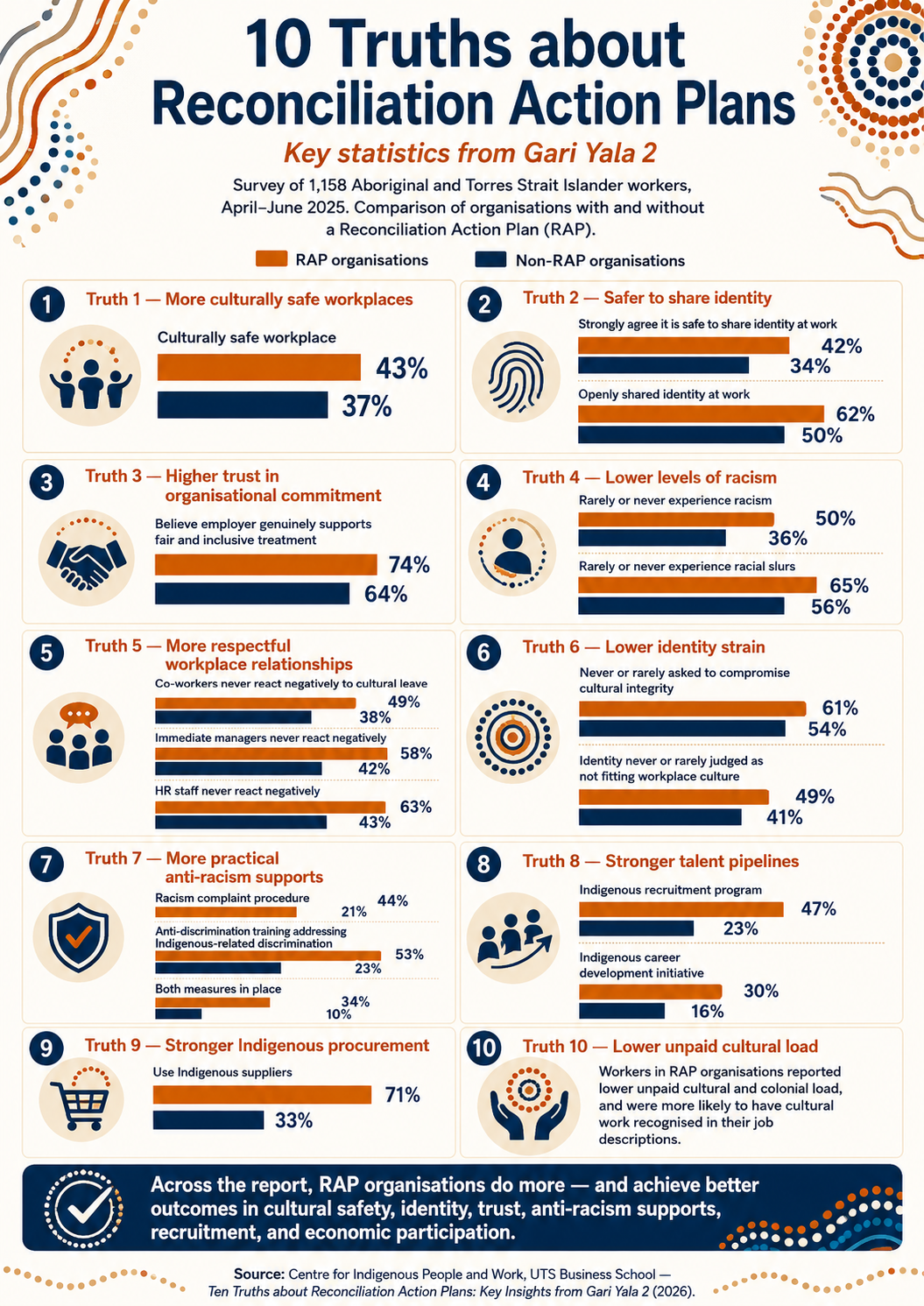
Illustration by Ngaarda Media, using data from the UTS Centre for Indigenous People and Work.
The figure is not a prediction of when workplace racism will end. It is an illustrative projection based on two survey periods and relates only to racial slurs, rather than every form of racism.
The research also found racism had consequences for employers.
First Nations workers who experienced racism sometimes, often or very often were three times more likely to intend to leave their employer within the following year.
They were also three times less likely to be very satisfied with their job or recommend their workplace to another Aboriginal or Torres Strait Islander person.
RAP organisations recording better outcomes
A companion report, 10 Truths about Reconciliation Action Plans, used the survey data to compare First Nations employees working in organisations with and without a Reconciliation Action Plan, or RAP.
RAPs have operated in Australia since 2006 and are built around relationships, respect and opportunities. Reconciliation Australia says one in five Australians now works or studies in an organisation with a RAP, making their effectiveness an important national workplace issue.
The new analysis found employees in RAP organisations generally reported better experiences across cultural safety, identity, racism, workplace support and career development.
About 43 per cent of First Nations employees in RAP organisations considered their workplace culturally safe, compared with 37 per cent in organisations without one.
Workers in RAP organisations were also more likely to openly share their Aboriginal or Torres Strait Islander identity at work, at 62 per cent compared with 50 per cent in workplaces without a RAP.
Trust was higher as well, with 74 per cent of workers in RAP organisations believing their employer genuinely supported fair and inclusive treatment, compared with 64 per cent elsewhere.
The differences were particularly clear in the availability of practical anti-racism measures.
About 44 per cent of employees in RAP workplaces reported having access to a racism complaint procedure, compared with 21 per cent of those in non-RAP organisations.
Anti-discrimination training addressing racism against First Nations people was available to 53 per cent of employees in RAP workplaces, compared with 23 per cent in organisations without a RAP.
Workers in RAP organisations were three times more likely to report having both measures in place.
Front page of the UTS analysis report featuring artwork by Yuwalaraay/Muruwari woman Kirsten Gray
The study found those systems were associated with lower reported racism.
However, the results also show that adopting a RAP does not automatically make a workplace culturally safe.
Fewer than half of First Nations employees in RAP organisations described their workplace as culturally safe, while half still experienced racism more frequently than rarely or never.
The findings suggest the difference lies not only in having a plan, but in whether its commitments are properly led, funded, measured and reflected in everyday workplace behaviour.

Illustration by Ngaarda Media depicting an example of ‘cultural load’
Employment and economic opportunities
RAP organisations were also more likely to have formal pathways for recruiting and developing First Nations employees.
Almost half of workers in RAP organisations reported that their employer had an Indigenous recruitment program, compared with 23 per cent in non-RAP workplaces.
Career development initiatives were reported by 30 per cent of First Nations employees in RAP organisations, compared with 16 per cent elsewhere.
The impact also extended beyond direct employment, with 71 per cent of workers in RAP organisations reporting engagement with Indigenous suppliers, compared with 33 per cent in organisations without a plan.
The survey was guided by a panel of 19 Aboriginal and Torres Strait Islander academics and employment practitioners. Data was collected between April and June 2025, and the report said the differences identified between RAP and non-RAP organisations were statistically significant.
Experiences informing national response
The findings have emerged as a federal parliamentary inquiry examines racism, hate and violence directed at Aboriginal and Torres Strait Islander people.
The inquiry is considering the prevalence and impact of racism, systemic discrimination, existing reporting systems and opportunities for reform. Its written submission period closed on June 1, with public hearings continuing across Australia.
During the submission period, Professor Young encouraged First Nations people to share their experiences and said workplace evidence should be considered by the inquiry.
She also highlighted the Call It Out First Nations Racism Register, which allows First Nations people and witnesses to confidentially record incidents without going through the demands of a formal workplace or tribunal complaint.

Call It Out social media graphic
The register was launched in 2022 by the UTS Jumbunna Institute and the National Justice Project. Reports are analysed to identify patterns, document the effects of racism and inform research and anti-racism responses.
The evidence shows that Reconciliation Action Plans can make a measurable difference, but a document alone cannot challenge racism, redistribute cultural work or create trust.
That depends on what happens after the commitments are written: whether leaders listen, whether racism is acted on and whether First Nations employees are supported to do the jobs they were employed to do without carrying an additional and largely invisible burden.
A future without workplace racism should not be measured in centuries. The research shows the tools for faster progress already exist — and the next measure of reconciliation will be whether employers are prepared to use them.