
“YOU ARE GOOD ENOUGH” INDIGENOUS DOCTOR OF THE YEAR DR TALILA MILROY URGES NEXT GENERATION INTO MEDICINE
By Lynnese O’Donoghue
Yindjibarndi and Palyku doctor Dr Talila Milroy says culturally safe healthcare, strong Aboriginal leadership and listening directly to women are central to improving health outcomes for First Nations families.
Dr Milroy, a general practitioner, researcher and medical educator, was recently named 2026 Indigenous Doctor of the Year by the Australian Indigenous Doctors’ Association, recognition she says came as a surprise.
Speaking with Ngaarda Media’s Lynnese O’Donoghue, Dr Milroy said the award reflected not only her own work, but the influence of the strong women and community leaders who had shaped her journey.
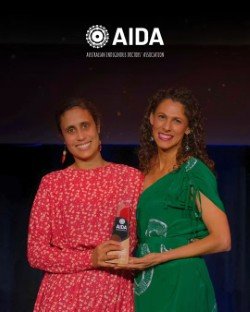
Dr Talila Milroy receiving her award as 2026 Indigenous Doctor of the Year. Photo Credit of AIDA
“I was surprised because there’s a lot of amazing Aboriginal and Torres Strait Islander doctors out there.”
She said her grandmothers received a special mention in her acceptance speech.
“I had to make sure I thanked all the really strong women in my life that have guided me and taught me over the years, especially my two grandmas.”
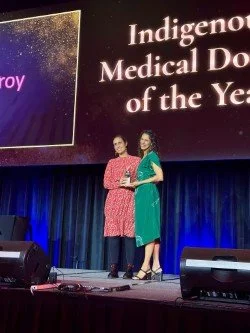
Dr Talila Milroy receives 2026 Indigenous Doctor of the Year
Dr Milroy is a Yindjibarndi and Palyku woman who works as a GP with Babbingur Mia Maternal and Child Health Aboriginal Corporation in Perth and as a lecturer and PhD researcher at the University of Western Australia.
FAMILY AND COMMUNITY SHAPED A CAREER IN HEALTH
Dr Milroy told Ngaarda Media she did not always know she wanted to become a doctor.
Instead, she knew from an early age that she wanted to work with Aboriginal people in a role connected to social justice.
Both of her grandmothers were members of the Stolen Generations, experiences she said gave her a strong understanding of the injustices Aboriginal people have faced since colonisation, while her family also showed her the strength of Aboriginal leadership.
“Having those role models just to see that we have an obligation to give back and to keep being leaders.”
Dr Milroy initially began studying journalism before moving into science and ultimately medicine.
WHY HAVING AN ABORIGINAL DOCTOR MATTERS
For Dr Milroy, working in Aboriginal community-controlled health remains one of the most rewarding parts of her career.
She said patients frequently told her they valued being able to see an Aboriginal doctor because some cultural experiences did not need to be explained.
“When they come into the clinic and into the consultation room, they know they can feel safe.”
She said Aboriginal patients could sometimes leave things unsaid, knowing their doctor already understood parts of the world they were coming from and what mattered to them.
Dr Milroy said cultural safety, however, should never be assumed — even for Aboriginal health professionals.
“Even though I am Yindjibarndi and Palyku, I can’t just assume that I’m culturally safe. So it’s always a lifelong learning journey.”
As her career has progressed, she said she has increasingly used her positions in clinical and university settings to raise concerns, advocate for cultural safety and help bridge understanding between Aboriginal communities and the broader health system.
PUTTING ABORIGINAL WOMEN AT THE CENTRE OF MENSTRUAL HEALTH
A major focus of Dr Milroy's recent research has been menstrual health among Aboriginal women.
The work began through conversations in her clinical practice with women experiencing period-related health concerns who either lacked reliable information or had previously sought medical help without getting the support they needed.
Dr Milroy and her colleagues went on to conduct research with Aboriginal women and develop culturally appropriate menstrual health resources in partnership with community.
Dr Milroy says the project included yarning circles with Aboriginal women and resulted in resources covering womens health. The resources were launched during Women's Health Week in 2026 and feature artwork by Aboriginal artist Erika Fernandez.
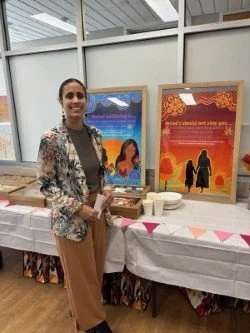
Dr Talila Milroy with her co-designed women’s resources that were launched during women’s health week in 2026
Dr Milroy told Ngaarda Media the resources were deliberately co-designed.
“The community really had the final say on the colours and the wording and the pictures and everything that was included.”
Community members also made an important distinction around who should have access to different information.
Some resources covering menopause and periods after pregnancy were identified as women's business. But information about a girl's first period was deliberately designed so fathers, brothers and other family members could learn too.
“They really felt that it’s important for the men to start being aware and being able to support the women in their life as well.”
Dr Milroy had already identified a significant shortage of culturally appropriate menstrual-health information designed specifically for Aboriginal women in Australia.
CULTURAL SAFETY SHOULD BE EVERYONE'S BUSINESS
Looking ahead, Dr Milroy said she wanted Aboriginal people to be able to receive culturally safe healthcare regardless of which clinic or service they attended.
“I would like to see that people can go anywhere for their care, that they don't have to come to a community controlled organisation to get the care that they need.”
She said every clinician should recognise cultural safety as part of their responsibility, alongside greater and more consistent funding for programs that Aboriginal communities know work.
“I'd like to see programs that actually work for our people being well funded and well supported.”
“YOU ARE GOOD ENOUGH”
Dr Milroy also had a clear message for young Aboriginal and Torres Strait Islander people considering careers in medicine.
She said students often approached medical studies believing they were not smart enough to succeed.
Her response is simple.
“You are.”
Dr Milroy said determination, commitment and hard work mattered more than being the smartest student in a classroom, adding there were now multiple pathways into medicine and growing support for Aboriginal medical students.
“There’s lots of support there to get you into the course… and more and more universities are focused on increasing the number of Aboriginal medical students.”
She said she and other Aboriginal doctors were also available to encourage the next generation.
“We’re always here to give advice. Anyone can reach out anytime.”
For Dr Milroy, the Indigenous Doctor of the Year honour recognises a career that connects medicine, research, culture and advocacy — while keeping Aboriginal communities at the centre of decisions about their own health.
Congratulations again, Doctor Talila Milroy on becoming 2026 Indigenous Doctor of the Year, from all of us here at Ngaards Media.