
IERAMUGADU AND ‘THE SISTERS’ - ACROSS THE KITCHEN TABLE
A story of connection beyond culture and time
Article by: Sean-Paul Stephens, with guidance from Michael Woodley.
Yindjibarndi leader Michael Woodley and I sat across the kitchen table, in suburban Melbourne, with three sisters. The three surviving sisters of the late Sister Bernadette Kennedy.
Amongst many stories, we spoke about a photograph.
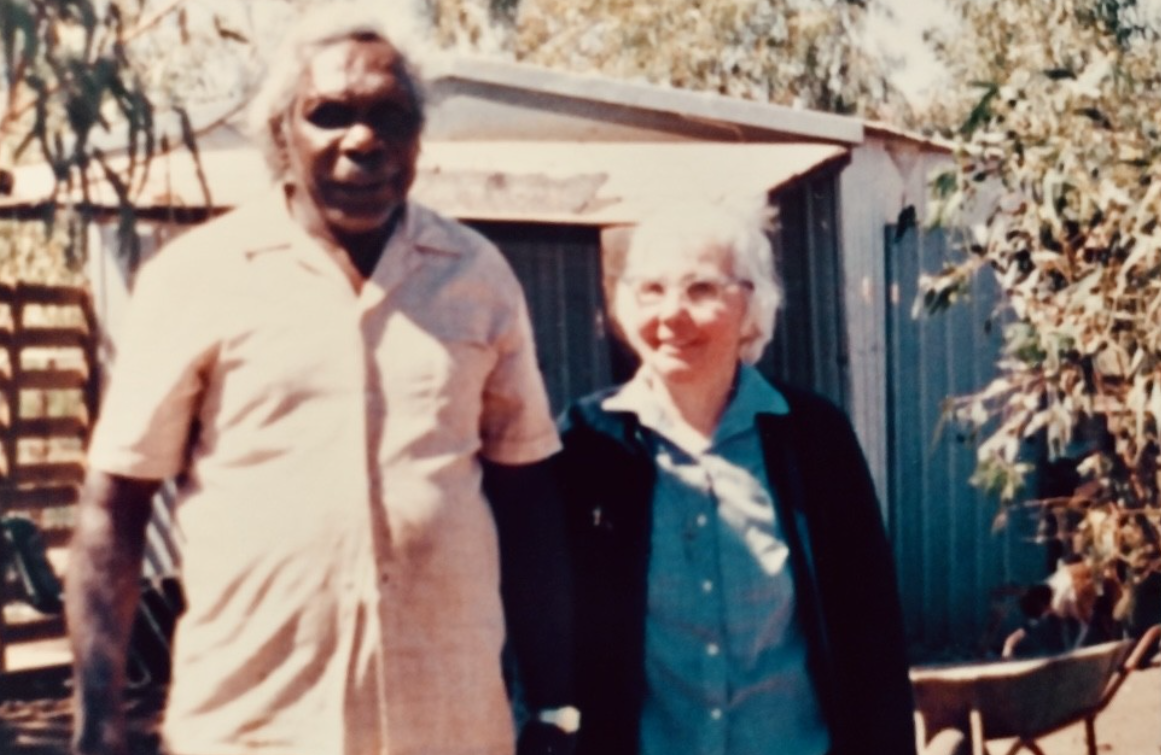
It is a photograph of Woodley King standing beside Sisters Bernadette Kennedy and Bernardine Daly. It captures something far more enduring than a moment in time.
Until 1975, Ngarluma, Yindjibarndi and other Aboriginal nations in the region had been forced to live on the Old Reserve on the outskirts of Roebourne town, approximately 1,500km north of Perth in the hottest part of Australia; the remote Pilbara.
Generations of Ngurrara-ngarli (Traditional Owners) were confined to the Reserve under government control. When government authorities decided closed the Reserve, families were forcibly relocated into what became known as “The Village”. Rows of basic housing that quickly became synonymous with disadvantage, overcrowding and despair. But for many who remember living in The Village, it was also home. The pain of memory is mixed with nostalgia.
In 1978, the forced relocation was still fresh for the Ieramugadu community. The trauma was raw.
The Village would later become the focus of national outrage after the death of 16-year-old Yindjibarndi boy John Pat in 1983 following an altercation with off-duty police — a moment that exposed to the country the injustices of Roebourne, and led to the Royal Commission into Aboriginal Deaths in Custody (1987-1991.
It was into this context that Mercy Sisters, Bernadette Kennedy and Bernardine Daly stepped. Nuns from a far away city.
As journalist and author Paul Cleary recorded in 2021, Sister Bernadette later reflected that while media reports prepared them for social dislocation, what struck them most was the spiritual authority of the Elders.
“We had the extraordinary privilege of meeting many old men and women, elders, who shared their stories with us, took us into country and exhibited a spiritual connection with land that was not just words but lived experience.”
She observed that Yindjibarndi Ngurra was clearly the nucleus of people’s spirituality and identity. Yet legally, it was not recognised as theirs at all (Cleary, 2021). Spiritually sovereign. Legally dispossessed.
One of the first Elders she met was Yindjibarndi man Woodley King.
“I’ve been praying for someone to come and help us,” he told her when they met (Cleary, 2021).
At the time, Woodley King was struggling with his own trauma, following dispossession and dislocation from his homelands. With encouragement from the Sisters, he found a renewal of his own cultural faith in Mingkala (“the Creator”), and he rebuilt his life. As he told The West Australian in 1984: “I did that and he [Mingkala] came alright.”
From that turning point emerged leadership of rare substance.
Woodley King envisioned a return to Ngurra (Country) for healing all Yindjibarndi people. He would name the community he was to build on the banks of a river on his Country, “Ngurrawaana”, meaning “going back to Country or back home”. He secured tenure at the site so families could reconnect with land and young people could be raised in culture and law, away from the chaos of The Village. It was built with limited resources and immense determination. River sand was mixed by hand to build foundations which were poured with wheelbarrows. Water was drawn from a nearby spring.
Among the children taken bush was his grandson, Michael Woodley. He would later instruct Michael to build on his leadership, and advance the Yindjibarndi nation.
Cleary recounts in his 2021 article Michael’s memory of his grandfather before the Sisters arrived.
Woodley King was “lost and confused by alcoholism”, Michael recalled. But with the support of many, including the two Sisters, he would instigate a resurgence of Yindjibarndi people that continues today.
This week, decades later, Michael Woodley and I sat at a kitchen table in Melbourne with Bernadette Kennedy’s three surviving sisters.
Bernadette’s sister Annie recalled with tears in her eyes, her first visit to The Village, where many leaders from Roebourne were raised.
“I realised how sheltered we had been in Melbourne. I couldn’t believe this was the same country, that this was Australia. People were forced to live in such devastating circumstances,” she said.
Pauline Kennedy, another of Bernadette’s younger sisters, who had also spent time as a nun and taken a vow of poverty, reflected on the same shock.
“Nuns take a vow of poverty. But when we got to The Village in Roebourne, I realised that we had no idea what real poverty was,” Pauline said.
She remembered her time meeting Woodley King, and seeing the Country where Mr King would build Ngurrawaana. Remembering it as “without any buildings, not even a toilet”.
Today Ngurrawaana is not only the home and office of YNL CEO and NYFL Chairman Michael Woodley, it is the heart of Juluwarlu Corporation, Yindjibarndi Rangers, Yindjibarndi Water protecting the heartbeat of Ngurra and soon to play a central role in the Yindjibarndi-led renewables project.
On reflecting on the role the Mercy Sisters played in Roebourne and the course of Woodley King’s life, it would be naive to ignore the broader history.
Across Australia, especially the Pilbara, missionary activity and religious zeal have caused deep harm.
At the hands of religious institutions, First Nations’ culture was suppressed. Authority was imposed. Families were separated. That truth remains.
And yet, sitting at that Melbourne kitchen table, another truth was evident.
All the sisters spoke not only of hardship, but of enrichment. It appeared that enrichment went both ways. It was less about relation, and more about human kindness. Roebourne changed them. The Aboriginal community enriched their lives.
They spoke of the brilliance of Elders. Of the fierce dedication to ensure the next generation would overcome colonial barriers. Of laughter, learning and spiritual depth.
What began in the shadow of “poverty”became something enduring.
The Sisters’ connection extended across the community, beyond Mr King. Following the passing of 16 year old John Pat, John’s mother, Mavis Pat, spent time with the Sisters in Bindoon.
A relationship formed in 1978 continues — in Ieramugadu (Roebourne), Ngurrawaana, in Yindjibarndi leadership, and now in suburban kitchens thousands of kilometres away in Melbourne.
Across differing faiths and spirituality.
Across two cultures.
Across multiple generations.
For Michael Woodley, and many others who remember the Sisters, the photograph of Woodley King and the Sisters is evidence that even within painful chapters of Australian history, relationships grounded in humility, respect and human kindness can shift the trajectory of families — and perhaps even of nations.
It is also worth remembering that perhaps the greatest legacy the Sisters’ left in Roebourne was gifting to a young Michael Woodley, Nelson Mandela’s Long Walk to Freedom. Mandela’s philosophy of nation-building was not rooted in revenge or rhetoric, but in disciplined resilience, moral authority and the long view of history.
He understood that real power lay in uniting people around legitimacy, culture and shared destiny — even after profound injustice. That approach resonates deeply in the Yindjibarndi journey. Michael’s leadership, and that of the Yindjibarndi Elders, has reflected a similar steadiness: asserting rights without surrendering dignity, pursuing justice through institutions rather than abandoning them, and grounding political strategy in cultural continuity.
Like Mandela, Yindjibarndi leadership has recognised that nation-building is about ensuring that sovereignty is lived.
- Sean-Paul Stephens is a social justice writer-and-advocate, and the Chief Executive Officer of the Ngarluma Yindjibarndi Foundation Ltd (NYFL). Sean-Paul resides on Ngarluma Ngurra (Country) in the Pilbara, though this article was written from Bunurong Country, Victoria following the birth of his third child.
[Reference: Cleary, P. 2021:
https://therecord.com.au/news/feature/mercy-sisters-yes-to-the-pilbara-leaves-lasting-legacy/]