
KARRATHA POLICE ARREST GONE WRONG EXPOSES FAILINGS, AS COMPLAINTS MOUNT
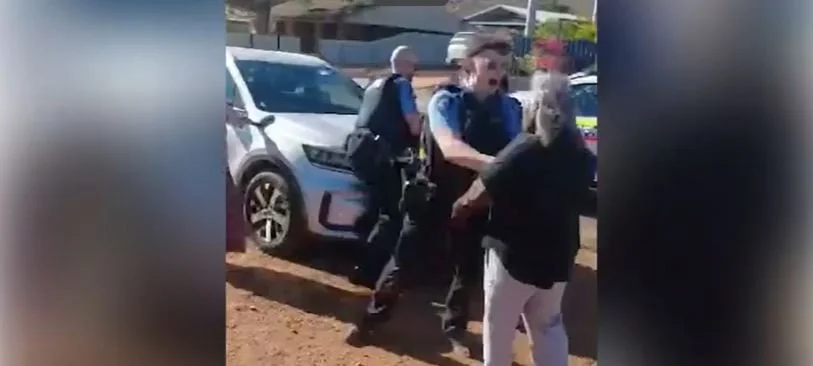
A still image taken from the video, depicting a WA Police Officer pushing 63-year-old Aunty Beverley to the ground.
KEY POINTS:
COMPLAINTS ABOUT WA POLICE MORE THAN DOUBLE IN THREE YEARS
WA FIRST NATIONS PEOPLE ARRESTED ABOUT 40,000 TIMES A YEAR
MOTHER SAYS HER SON’S ARREST AMOUNTS TO “POLICE BRUTALITY”
WA POLICE SAY CULTURAL TRAINING MANDATORY, DESPITE FAILINGS
By Daniel Burdon
It was about 8.30am on Tuesday morning in September, when tensions escalated outside a home in Pegs Creek, Karratha.
Three WA Police officers had attended the property to arrest a 33-year-old Aboriginal man facing several charges, including criminal damage, reckless driving, obstructing a police officer and disorderly behaviour in a police station or lock-up.
But the arrest did not go to plan.
The man’s mother, Denise Hubert, who lives in Onslow, told Ngaarda Media police did not give her son an opportunity to explain himself before the situation escalated, and her son raised his voice.
“That's when they handcuffed him, pushed him to the ground, hitting him in the back of the head, and his mouth was bleeding,” she said.
Ms Hubert described what she witnessed as “police brutality” - a term also used by other witnesses at the scene, who asked not to be named.
But WA Police has provided a different account of some aspects of the incident.
But there is no dispute that a video filmed by a witness and later shared widely on social media showed the confrontation escalating after the arrest.
It includes an officer pushing Ms Hubert’s sister, Aunty Beverley, a 63-year-old Aboriginal woman and dialysis patient, to the ground.
Capsicum spray was also used on at least two women during the confrontation.
The footage sparked anger in parts of the Pilbara Aboriginal community and renewed calls for police officers working in regional WA to receive stronger and more locally relevant cultural training.
Those calls for more and better cultural training echoes recommendations made by WA Coroner Ros Fogliani in 2025 for mandatory Aboriginal cultural awareness training for police serving in regions including the Pilbara.
The Coroner recommended training be co-designed and delivered face-to-face by Aboriginal people, rather than relying primarily on online learning.
WA Police said in a statement that officers undertake mandatory cultural training and those stationed in the Pilbara also undertake a regional cultural induction.
But WA Police would not say who delivers the training, or where, or whether it involved specific local Aboriginal community-controlled organisations.
It is unclear whether or not the officers involved in the arrest and altercation that followed attended cultural or de-escalation training before being deployed to the Pilbara.
Aboriginal Legal Service of WA chief executive Wayne Nannup says incidents such as the one in Karratha suggest significant problems remain.
Mr Nannup said the response towards Aunty Beverley shown in the footage was unacceptable.
“That old girl that I saw in that video was not, I don't think, in any way intimidating at all,” he told Ngaarda Media.
“She wasn't standing anywhere near that police officer.
“To take that response … there are a number of those types of incidents which are common, but completely unacceptable.”
Mr Nannup, who has worked in the Aboriginal legal sector for over a decade, said the organisation continues to see First Nations people disproportionately represented throughout the justice system.
ALSWA receives about 40,000 custody notifications each year, according to figures provided to Ngaarda Media, in a state where the Aboriginal and Torres Strait Islander population is about 89,000.
But given the number of arrests of First Nations people in WA, comparatively few indigenous West Australians lodge formal complaints about their treatment by police.
Ngaarda Media obtained figures showing complaints about WA Police to the WA Ombudsman have more than doubled over the past three years, with the vast majority about the conduct of individual officers, investigations and prosecutions of crimes.
Principal Assistant Ombudsman for Complaint Resolution Brianna Lonie said an increase in complaints did not necessarily mean police conduct had worsened, with greater public awareness of oversight agencies potentially contributing to the rise.
The Ombudsman is an independent agency tasked with overseeing investigations into state government departments, local councils and the police, unless a complaint relates to serious police misconduct - which are referred to the Corruption and Crime Commission.
Complaints about WA Police have been the third biggest source of public complaints to the Ombudsman in the past three years, behind all local councils combined, and the corrections system.
“The volume of (police) complaints, while the percentage increase appears to have doubled, the total volume of complaints is relatively low,” Ms Lonnie said.
She said complaints involving WA Police could cover a wide range of issues, and increases could prompt the Ombudsman - to work with an agency to identify possible improvements in communication, policies or procedures.
Ms Lonnie also said the Ombudsman’s office was currently preparing a plan to publicly detail what specific systemic issues it plans to conduct its powerful “own-motion investigations” into - probes where politicians and senior public servants do not set the agenda.
For Mr Nannup, however, the issue sits within a much longer history.
“Those numbers … really emphasise an historical breakdown of relationships between the police and Aboriginal people in WA,” he said.
He said senior police may genuinely be seeking to improve relationships, but experiences at community level could be very different.
“When it comes down to people and police on the beat or on the streets, it's a completely different thing,” he said.
Mr Nannup said greater engagement between police and Aboriginal communities, including community-led justice initiatives, could help rebuild trust.
“I think there's a lot more work that needs to be done there, and particularly in the regions,” he said.
“It's essential to create a better understanding around what's going on in community, and also a better understanding between community and police.”
That challenge was evident in the Pilbara this week when local Aboriginal leaders attempted to organise a meeting between police and community members.
Ngaarda Media understands some police attended, but few community members ultimately took part, due to a lack of trust that the meeting would lead to any significant change.
WA Police has previously said officers are trained to use the minimum force necessary, continually reassess incidents and de-escalate where possible, and that use of force must be justified, proportionate and subject to mandatory reporting and review.
Police said Aunty Beverley “fell over” during the incident and declined medical assistance. She has been summonsed to appear in court over an alleged assault on public officers.
The 33-year-old man and two other women also face charges arising from the incident.
For Denise Hubert and her family, the legal process is now continuing alongside their concerns about the way they were treated.
The family plans to lodge a formal complaint and is considering further action.
Despite that experience, Ms Hubert said she does not want relations between Aboriginal people and police to deteriorate further.
Instead, she wants officers to receive better preparation for working with Aboriginal communities.
“They need to have further training into dealing with Aboriginals,” she said.
“We get on terms with our cops in Onslow … and there's a big difference.”