
WESLEY LOCKYER FOUNDATION BORN FROM FAMILY’S FOUR-YEAR SEARCH FOR ANSWERS
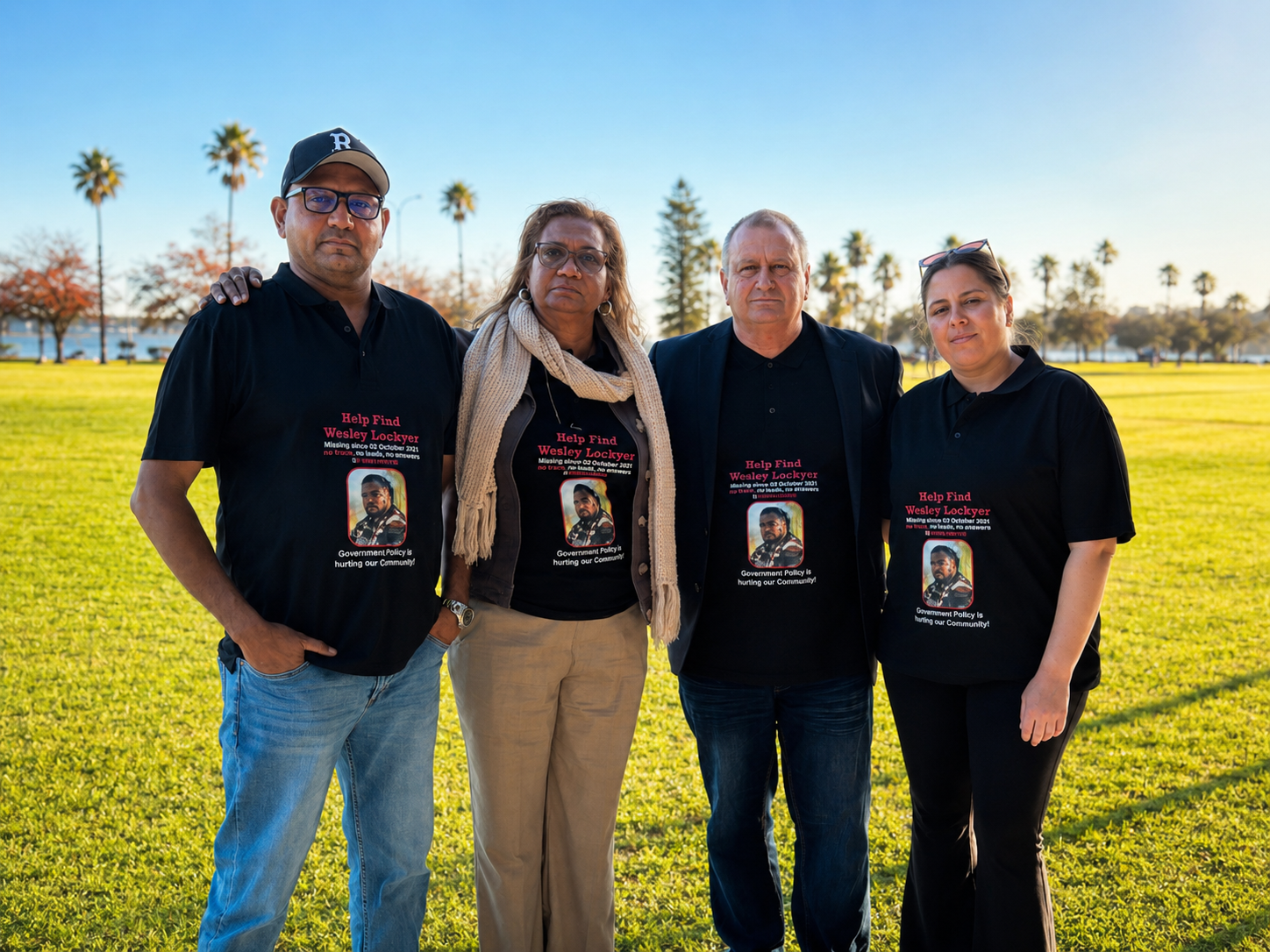
Brenden Taylor, Joanne Taylor, Peter Van den Berg and Jacinta Ramirez-Smit at the Wesley Lockyer Foundation meet and greet. Image: Ngaarda Media
By Katherine Glass
A Pilbara mother whose son has been missing for almost four years has launched a foundation she hopes will ensure other families do not have to navigate the search for a loved one alone.
UPDATE, AUGUST 19: WA Police has responded to questions from Ngaarda Media regarding the investigation into Wesley Lockyer’s disappearance. Their response has been added to this article below.
The Wesley Lockyer Foundation was formally introduced to supporters at a meet-and-greet in Perth, bringing together families of missing people, search volunteers, advocates and people who have spent years trying to keep unresolved cases in the public eye.
Wesley Lockyer was 29 when he disappeared from the Jinparinya Aboriginal Community, near Port Hedland, in October 2022.
His mother and foundation founder, Joanne Taylor, told those gathered that the organisation had been created from what her own family had learned since Wesley disappeared.
"The Wesley Lockyer Foundation was created with the aim to be that support that we never had, as Wesley's family needed, and provide support for families of missing loved ones," she said.
"We've spent four years navigating a broken system and developing a network of people who genuinely care.
"No family should ever search alone."
'WHAT DO WE DO NOW?'
Ms Taylor said the disappearance of a loved one could place families under enormous emotional, physical and financial pressure, particularly when an initial search had ended but there were still no answers.
She described families living through "the torture of not knowing where their loved ones are" and the "immeasurable pain and ongoing grief" that followed.
Ms Taylor said her family repeatedly found themselves confronting the same questions.
"What do we do now? Where do we turn to for help? Who can we go to for the guidance? Who is going to help us?" she said.
"So we're left to face this alone. What do we do?
"And that's basically what we're trying to achieve here with the foundation — to help our families, help other families to be able to unite and be able to assist them in every way we possibly can."
It was a theme she returned to in an interview following the event.
"My son's been missing for almost four years and we've gone through the highs and the lows," Ms Taylor said.
"We found out what works for us and what doesn't work for us."
She said the family had protested, sought help from advocates and engaged with government agencies while campaigning for changes to the way long-term missing persons cases were handled.
FAMILY FORCED TO ORGANISE ITS OWN SEARCH SUPPORT
Ms Taylor used the family's experience of bringing a human remains detection dog team to Port Hedland as an example of the practical barriers families could face.
She said her family located Georgia and Michael from the Human Remains Detection Dogs team after searching for specialist assistance themselves.
"They drove all the way to Port Hedland to help us," she said.
Ms Taylor said the family then had to organise and pay for the team's visit, including finding somewhere that would accommodate the handlers and their four dogs.
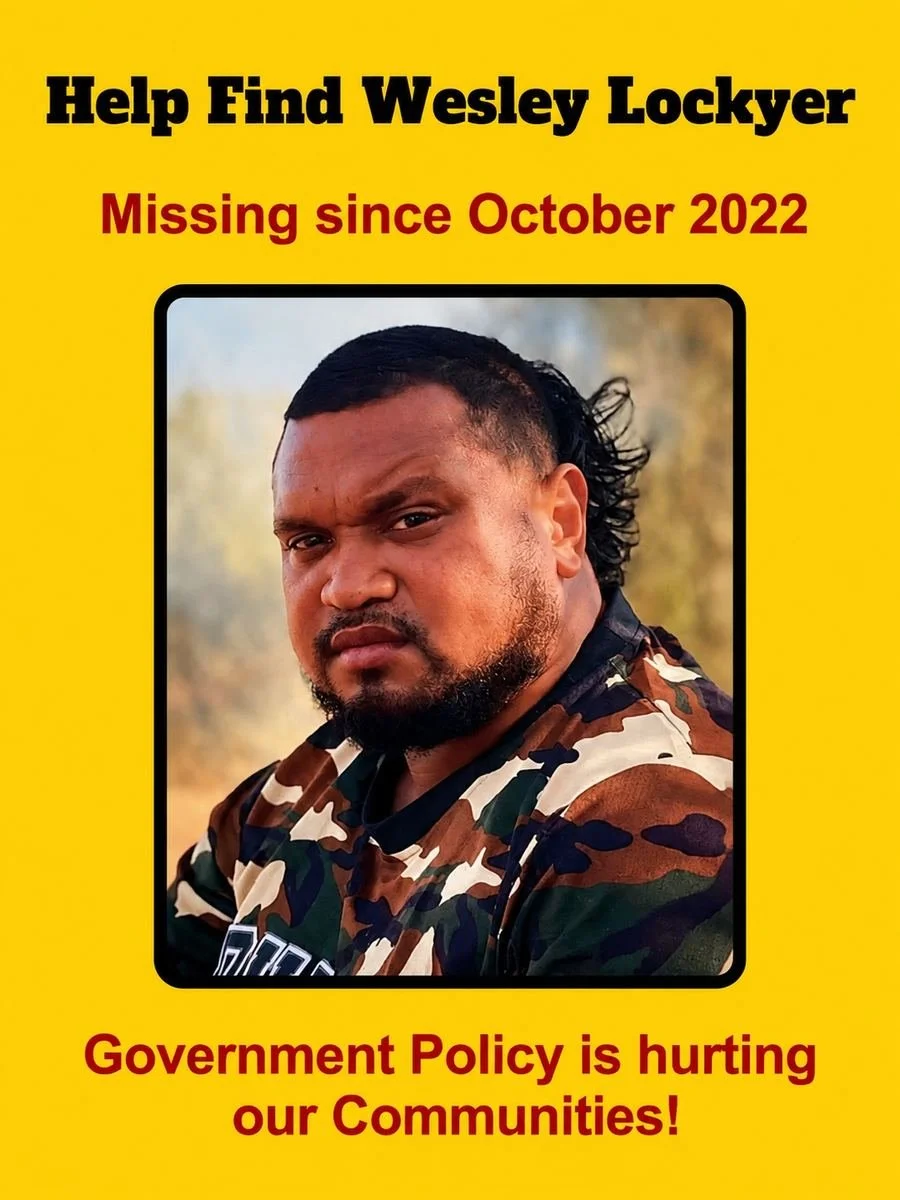
Missing Person poster by Wesley Lockyer Foundation
"We managed to get the team accommodation because there was just nothing, absolutely nothing set up up there at all," she said.
"So, a lot of trials and tribulations there."
The family also had to consider the welfare of the dogs and handlers working in Pilbara conditions.
"We also had to make sure that the team was in good condition to be able to walk the terrains up there in the Pilbara heat," Ms Taylor said.
The account is one of the experiences the foundation says has influenced the type of practical assistance it wants to offer other families.
'WE HAD TO DO IT OURSELVES'
Ms Taylor’s husband, Peter Vandenberg, told the gathering the family had struggled to know where to turn once the initial response to Wesley's disappearance had passed.
"We didn't know who to turn to after the police had done their initial investigation," he said.
"We didn't know what to do. So we had to do it ourselves, and the family did it ourselves to keep on searching for Wesley."
Mr Vandenberg said he believed other families with missing loved ones had faced the same situation.
He said the foundation's intention was not to limit its work to Aboriginal families, but ultimately to support people with missing relatives across Western Australia.
He thanked Nyamal Elders and Rangers, Aboriginal corporations, local mining companies, investigators, search teams and other families of missing people who had supported the family.
"You've given us all the strength to continue our fight for justice for our loved ones," he said.
QUESTIONS ABOUT HOW MISSING PERSON CASES ARE HANDLED
Private Investigator Robyn Cottman also used the event to raise concerns about the way some long-term missing persons cases were investigated.
She argued disappearances should be approached as potentially suspicious early enough for evidence to be preserved, rather than escalated only after years had passed.
"The disappearance should be treated as suspicious until proven otherwise," she told attendees.
"That way, all the critical information and detail and evidence is collected first."
Robyn also questioned assumptions she said had been made about Wesley's disappearance and argued unanswered questions remained about the circumstances in which he vanished.
“They've made assumptions that Wesley was on drugs, that he walked off into the bush and died. But where is the evidence of that? Where is the evidence that Wesley was even under the influence of drugs when he went missing?” she said.
Those comments represent the views expressed by the foundation at the event.
WA POLICE RESPONSE
UPDATE — AUGUST 19, 2026: Following publication of this article, WA Police provided Ngaarda Media with a response regarding the investigation into Wesley Lockyer’s disappearance.
Ngaarda Media put a series of questions to WA Police about the concerns raised by Wesley Lockyer’s family and the Wesley Lockyer Foundation, including the investigation into Wesley’s disappearance and broader concerns about the handling of long-term missing persons cases.
WA Police said Wesley’s disappearance remains an open missing person investigation.
Police said Mr Lockyer was last seen leaving the Jinparinya Aboriginal Community in Pippingarra at about 6am on Monday, October 24, 2022.
According to WA Police, extensive searches were conducted following his disappearance, involving significant resources including a mobile police facility, police vehicles, local rangers, drones, a police helicopter and State Emergency Service personnel.
“However, despite extensive search efforts, Mr Lockyer was not located. The matter has since been reported to the State Coroner,” WA Police said.
Police said missing-person cases were treated as a priority regardless of where the person was reported missing and acknowledged the significant impact such investigations could have on families and loved ones.
WA Police said it remained committed to pursuing all available lines of inquiry and providing answers for those affected.
Police are continuing to seek information that could assist the investigation. A reward of up to $500,000 is available for information that directly leads to the location of a long-term missing person.
Anyone with information regarding Wesley Lockyer’s disappearance is urged to contact Crime Stoppers on 1800 333 000 or via the Crime Stoppers WA website.
FOUNDATION AIMS TO 'FILL IN THE GAPS'
The organisation says it wants to provide more than public awareness campaigns.
Robyn told attendees the foundation hoped eventually to help coordinate searches, identify potential search areas, connect families with investigative and legal assistance and assemble teams capable of continuing work after an initial search had ended.
"We're filling in the gaps, we're being proactive," she said.
"We want to be out there actively trying to get families answers.
"That's what the foundation is all about. It's not just … to create awareness."
Ms Taylor said the organisation remained in its establishment phase, but intended to provide families with guidance on reporting a missing person and dealing with police, as well as logistical assistance including four-wheel-drive transport, fuel, water and accommodation during searches.
It also hopes to provide media liaison, culturally appropriate advocacy and help coordinate volunteer searches alongside official services.
"This is just the start, this is just the beginning of the Wesley Lockyer Foundation," Ms Taylor said.
"We want to be able to get a great team together and … support other loved ones who've got family missing."
ANOTHER FAMILY'S 11-YEAR SEARCH
David Kehlet , whose brother Ray Kehlet and sister-in-law Jenny Kehlet disappeared while prospecting near Sandstone in 2015, also joined the foundation.
Ray's body was eventually found at the bottom of an abandoned mine shaft, while Jenny remains missing.
Mr Kehlet told the gathering his family's experience had shown how long families could live with what he described as "ambiguous loss".
"I see the purpose of the foundation being that fewer families will live in the agonising limbo of ambiguous loss by offering practical support, hope, right from the start," he said.
Mr Kehlet said his family spent years questioning the circumstances surrounding Ray and Jenny's disappearance.
A coronial inquest held several years later concluded Ray had been unlawfully killed and that Jenny was likely also the victim of homicide, although her fate could not be determined conclusively without her remains, according to Mr Kehlet’s account to the gathering.
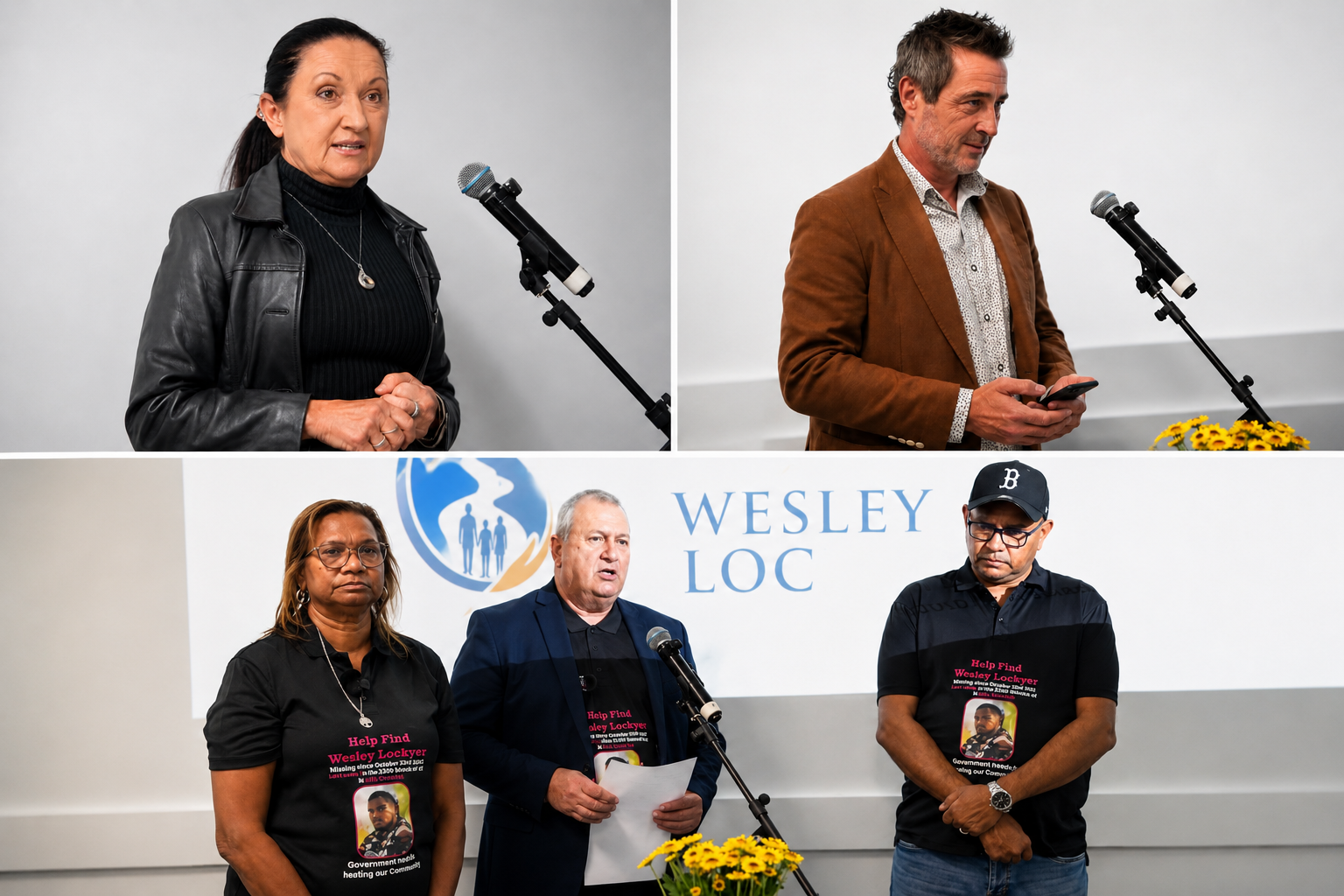
Meet and greet speakers: private investigator Robyn Cottman, case coordinator Dave Kehlet, directors Joanne Taylor and Peter Van den Berg, Brenden Taylor. Image by Ngaarda Media
He said family advocacy, journalists and volunteer searchers had all played a role in keeping the case alive.
"What kept Ray and Jenny's case alive wasn't just police work," he said.
"It was journalists, volunteers, members of the public, and ordinary people like us who refused to let it be forgotten."
For Mr Kehlet, those experiences demonstrated why families needed support over the long term.
"These are enormous distances," he said.
"All such efforts are exhausting, expensive, isolating and overwhelming on all involved.
"Families need help."
'NO FAMILY SHOULD HAVE TO CARRY THAT BURDEN ALONE'
Mr Kehlet said one of the most important lessons from his family's 11-year experience was persistence.
"Your missing loved one no longer has a voice. You are that voice," he said.
"No family should have to carry that burden alone. Our voices are louder together.
"Every missing person deserves to be remembered. Every family deserves to be heard. And no one should have to fight for answers alone.
"That is why the Wesley Lockyer Foundation exists."
MENTAL HEALTH AND PRACTICAL SUPPORT
Ms Taylor said mental health support would also be an important part of the foundation's work.
"The other thing we found as well with our family is the mental health," she said.
"Mental health is so important and so significant."
The foundation hopes to connect families with trauma-informed counsellors and peer support from people who understand what it means to have a loved one missing.
It is also seeking volunteers with skills including first aid, four-wheel-drive operations, drones, emergency services, radio communications and other areas relevant to remote searches.
"These are just safety things as well, to make sure that all our searches are professionally done," Ms Taylor said.
"And we have professional, skilled and qualified people."
'WE WANT TO BE ABLE TO HELP EVERYONE'
The foundation is now seeking volunteers, funding and partnerships as it builds its operations.
Ms Taylor said she was overwhelmed by the response to the meet-and-greet.
"I'm feeling absolutely mind blown because there's been a lot of support," she said.
"We just wanted to be able to get our message out and start getting the ball rolling for the Wesley Lockyer Foundation."
While the organisation carries her son's name, Ms Taylor said its purpose was now much broader than the family's own search.
"We want to keep it focused on all the families, not just our family," she said.
"We want to be able to help everyone."
Wesley Lockyer remains missing.
Anyone with information that could assist investigators is urged to contact WA Police or Crime Stoppers.
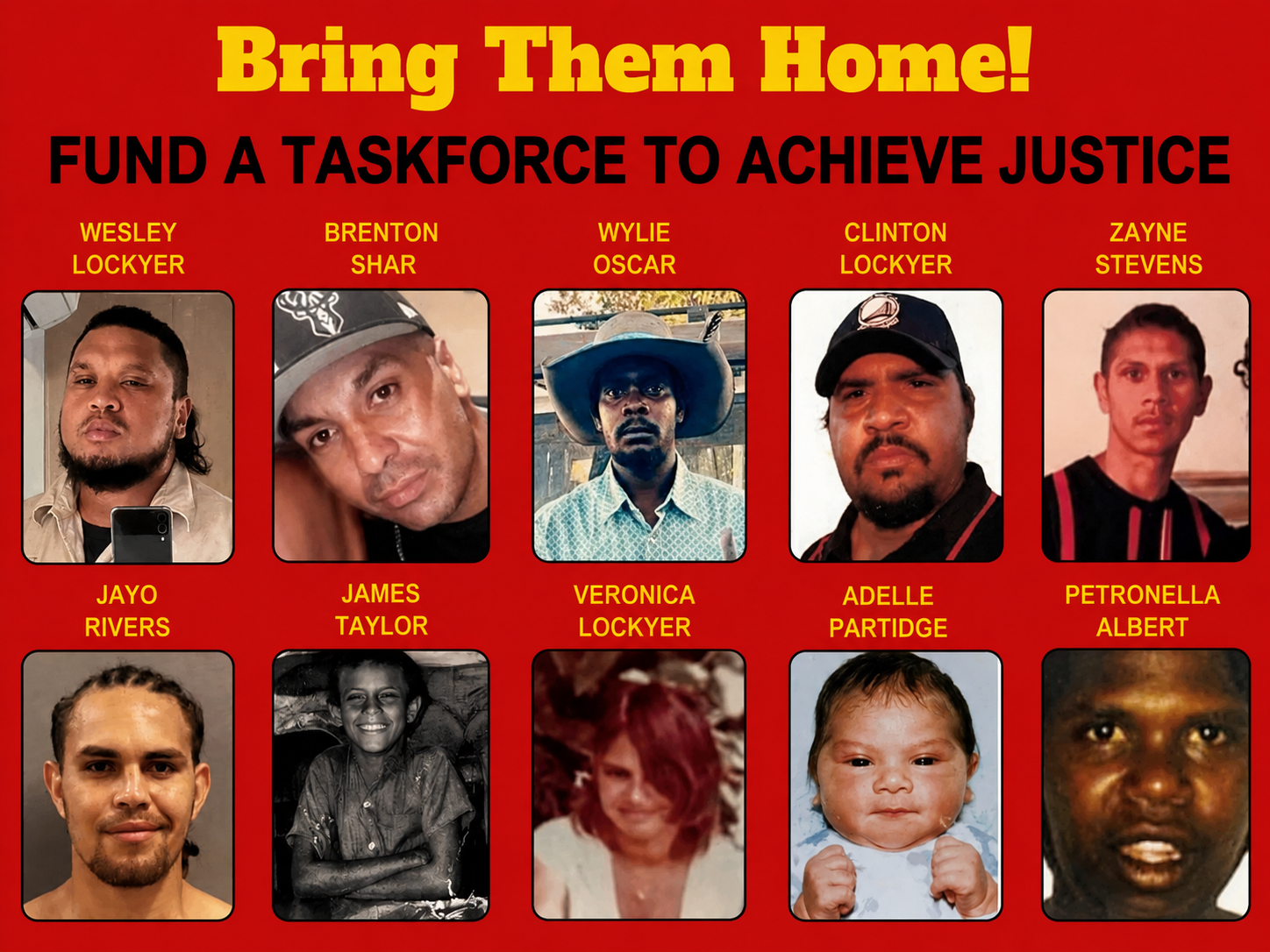
Missing persons poster by The Wesley Lockyer Foundation

Image: Facebook